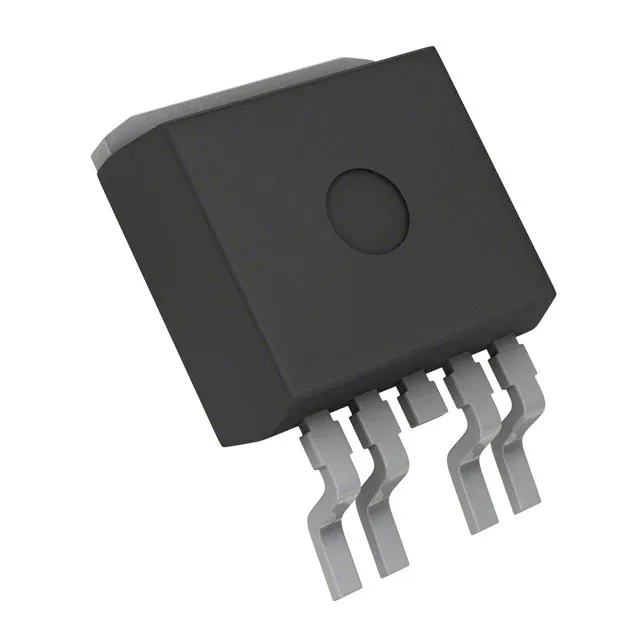
Its typical on-resistance of 190 mOhm at 25 °C sets the conduction loss: at the 1.6 A maximum continuous output, expect roughly 0.5 W dissipation in the switch alone — well within the TO-263-5 D²Pak package capability with proper board copper, but the thermal budget tightens as ambient climbs toward the 150 °C junction limit. The switch operates over a 4.7 V to 42 V load supply range, covering nominal 12 V and 24 V rails with headroom for load-dump transients. No external Vcc supply is needed — the gate drive is self-biased from the load voltage, which simplifies the BOM but means the switch cannot turn on below the undervoltage lockout threshold.
Fault protection set — integrated, no external watchdog
The BTS410E2 E3062A integrates fixed current limiting, open-load detection, overtemperature shutdown, and overvoltage clamping. The current limit is fixed — no external sense resistor or programming pin — which saves board area but means the limit profile is non-adjustable. The status flag output (open-drain, active low) reports fault conditions to the MCU, enabling software-based diagnostics without a separate ADC channel. The auto-restart feature cycles the output after an overtemperature fault once the die cools, which is useful for lamp inrush or motor-stall recovery but can mask a persistent short if the downstream controller does not latch off on the status flag.
Infineon lists the BTS410E2 E3062A as obsolete. For new designs, evaluate current-generation PROFET devices in the same TO-263-5 footprint — the pinout and function are consistent across the family, but confirm the Rds(on) and protection feature set against your load requirements.
The supplier device package is PG-TO263-5-2.