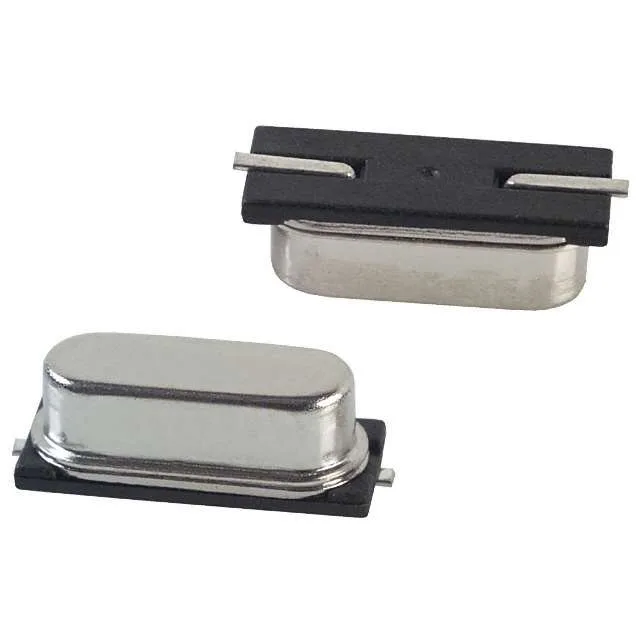
CSM-7 crystal — 25.4563 MHz at the board level
The ECS-254.563-CD-0380 is a 25.4563 MHz fundamental-mode crystal in the HC-49/US surface-mount package from ECS Inc.'s CSM-7 series — a common clock reference for MCU and timing circuits where a tight frequency tolerance is required at a known load capacitance.
±20 ppm tolerance and ±30 ppm stability — what that means in practice
The ±20 ppm frequency tolerance is the initial accuracy at 25 °C; the ±30 ppm stability spec covers the drift across the full operating temperature range of -10°C to 70°C. Combined, a design targeting a ±50 ppm budget for the crystal section has the headroom to absorb both the tolerance and the worst-case thermal drift without missing the UART baud-rate or RTC accuracy target. ESR is listed at 30 Ohms — this is the motional resistance the oscillator start-up circuit must drive. A higher ESR than typical does not affect steady-state accuracy but does affect start-up time and power consumption in the oscillator stage; the driving IC's gain margin must be checked against this figure for cold-start reliability.
12 pF load capacitance and SMT footprint
The crystal is specified for a 12 pF load capacitance, which means the PCB layout must present 12 pF total — including stray — between each pin and ground for the oscillator to pull to the correct frequency. Operating temperature is -10°C to 70°C — this is the commercial grade band, not an industrial -40 °C start. Designs targeting outdoor or engine-adjacent environments at temperature extremes need to verify the crystal stays within its stability budget or select a wider-temperature variant.