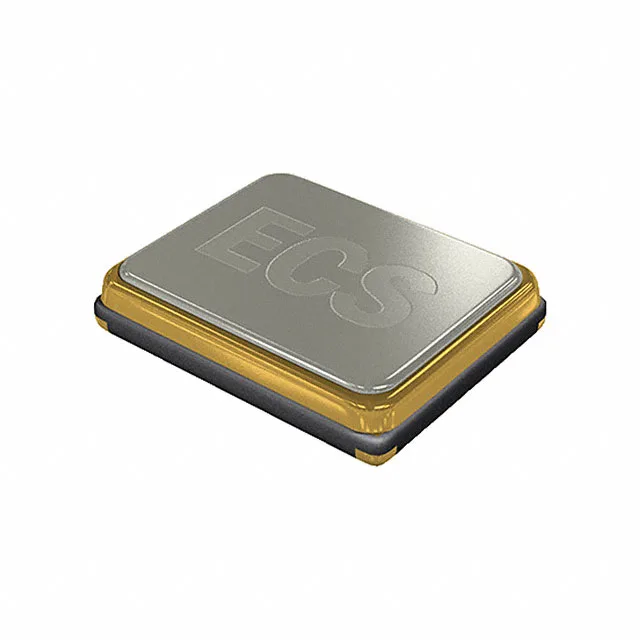
AEC-Q200 grade for automotive timing
The ECS-250-18-33QZ-ADS-TR: This 25 MHz fundamental crystal carries AEC-Q200 qualification — the automotive stress-screening standard covering temperature cycling, board flex, and moisture resistance.
Load capacitance and frequency accuracy
Load capacitance is 18 pF — the oscillator circuit must present this impedance to the crystal pins for the part to oscillate at its rated 25 MHz. A mismatched load capacitance pulls the frequency off nominal, and with only ±25 ppm tolerance on the crystal itself plus ±100 ppm stability over temperature, the circuit designer needs the load spec to stay within the total budget. The combined tolerance stack — ±25 ppm initial tolerance, ±100 ppm stability across temperature — gives roughly ±125 ppm total frequency error in the worst case, which is tight enough for most CAN/LIN and precision timing reference applications but warrants a check against the microcontroller oscillator circuit requirements.
ESR and drive level compatibility
Equivalent series resistance is 80 Ohms maximum. The oscillator start-up circuit drive level must be sufficient to overcome this at 25 MHz; an undersized or high-ESR crystal can fail to start, especially in low-supply-voltage designs where the drive current is limited. Confirm the MCU/SoC oscillator spec calls for a crystal with ESR at or below this value.
Footprint and package integration
The 3.20 mm by 2.50 mm 4-SMD no-lead package seats at 0.80 mm maximum height — a standard footprint in the timing section of most automotive MCU boards. The no-lead format requires a clean solder joint under the part body; inspect the X-ray for voiding on production boards, especially in thermally demanding environments. Available on tape-and-reel for high-volume placement and cut tape for prototype runs — order the cut tape variant for NPI to avoid breaking a full reel open.