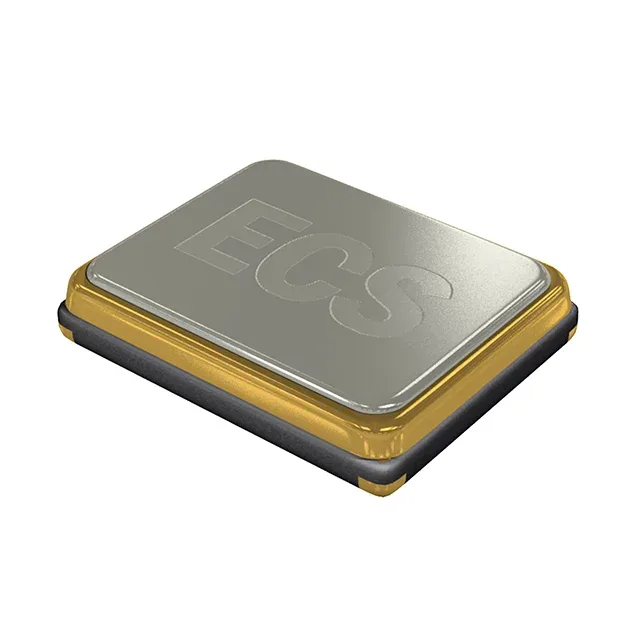
24 MHz crystal in the ECX-1637Q automotive series
The ECS-240-10-37Q-EP-TR: It is AEC-Q200 qualified, meaning it has passed the automotive-grade stress tests for passive components — temperature cycling, board flex, and moisture resistance — making it suitable for safety and powertrain control modules that see the full engine-bay temperature band.
Frequency tolerance, stability, and load capacitance
Frequency tolerance is ±30 ppm at 25 °C, and frequency stability across the operating range is ±50 ppm — together they define the total frequency error budget across all production extremes. Load capacitance is specified at 10 pF, so the PCB layout must present a total capacitive load in that range to the crystal pins to hit the nominal 24 MHz; a stray capacitance of 2–3 pF per node leaves 7–8 pF of discrete load capacitance as the design target.
ESR and drive level for startup reliability
Equivalent series resistance is 100 Ohms maximum — the crystal draws whatever drive level the oscillator circuit on the MCU or SoC supplies, within the drive-level specification of the ECX-1637Q series. Oscillator startup is guaranteed when the negative resistance of the oscillator circuit exceeds 3–5× the crystal ESR; with 100 Ω ESR the margin is comfortable for most automotive MCUs, but the layout and trace length from MCU oscillator pins to the crystal matter — keep the crystal close and the pad capacitance matched.