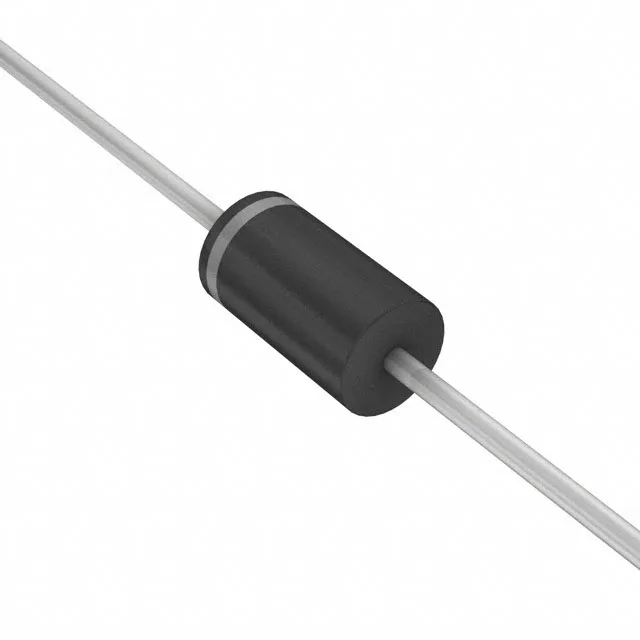
Transient suppression for a 7V rail — what the 1500W rating buys you
The 1.5KE8.2CA-G: With a 7V reverse standoff voltage, it sits across a 5V or 6V supply rail and remains transparent until a transient exceeds 7.79V breakdown — then it clamps the surge to 12.1V maximum while shunting up to 123.97A of peak pulse current. The bidirectional configuration means a single device protects both polarities on AC-coupled lines or symmetric signal pairs without needing two diodes back-to-back.
Active production — no last-time-buy pressure
This is a standard catalog TVS — not a niche or custom-screened device — so supply should track the normal production cycle of the 1.5KE series.
Temperature range and derating context
Rated for operation from -55°C to +150°C junction temperature — the full military-temperature window. The 1500W peak pulse rating applies at 25°C; above that, the device must be derated per the standard TVS derating curve (typically 1% per °C above 25°C, though the specific curve for the 1.5KE series should be referenced). At 150°C junction, the effective peak pulse power drops to roughly 810W — still adequate for most secondary-side protection in power supplies or I/O lines where ambient temperatures stay below 85°C.
Where it fits — general-purpose board-level transient protection
The 1.5KE8.2CA-G is classified for General Purpose applications — meaning it is not a dedicated automotive (AEC-Q101) or telecom (GR-1089) part, but serves the broad industrial and commercial transient-protection market. Typical uses include DC rail clamping on 5V or 6V supply buses, protection of signal lines in PLCs, sensors, and control panels, and surge suppression on low-voltage analog or digital I/O. The bidirectional nature suits it for AC-coupled data lines (RS-485, CAN bus) where the common-mode voltage can swing positive or negative relative to ground.