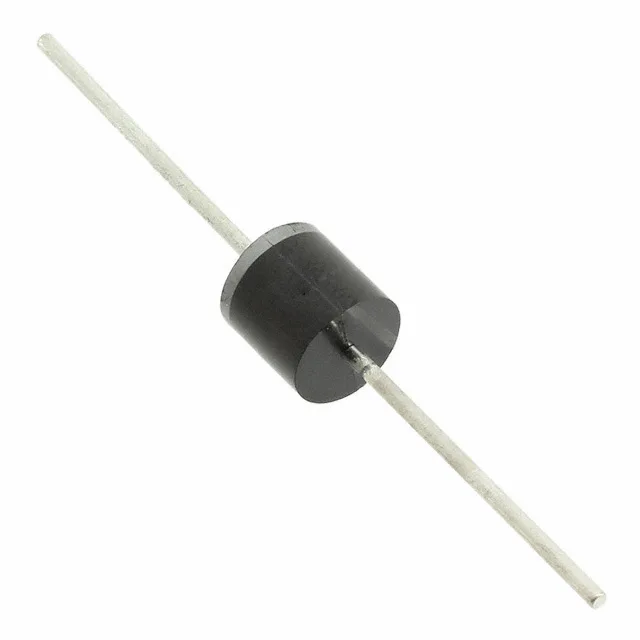
What the 5KP160A-G delivers on a board
The 5KP160A-G is a unidirectional Zener-based TVS in the 5 kW peak-pulse class, clamping a 160 V nominal standoff rail up to 259 V at a peak current of 19.31 A on a 10/1000 µs waveform — that is the primary fit decision for any transient-suppression slot on a DC bus. Breaking down the clamping chain: the reverse standoff of 160 V is where the device sits silently in normal operation; the 178 V minimum breakdown is the onset point; and the 259 V clamping maximum is what the downstream circuitry sees at the rated peak current. A design that budgets clamping margin against a 200 V transient spike is in the right window; one that expects sub-200 V clamping at full peak pulse is not — the 259 V ceiling is the hard limit, not a nominal target.
R-6 axial package and thermal integration
The R-6 axial body mounts through-hole, which gives the lead-frame a direct thermal path to the PCB copper — critical at 5 kW peak, even for a 10/1000 µs event. The datasheet derating curve ties junction temperature rise to lead length and pad copper area; under worst-case layout the 150°C maximum junction temperature can be reached faster than the pulse interval allows cooling, so verify the duty cycle against the thermal budget before locking in the mount position. Tape & Box packaging is standard for axial TVS parts ordered through distribution — the part ships with leads formed to the reel pitch rather than loose in a bag, which protects the body and leads during automated insertion.
Junction temperature grade and deployment
A product running the 5KP160A-G in a 105°C ambient still has 45°C of junction margin above the 150°C limit at steady state, but that margin erodes sharply once the pulse train starts.