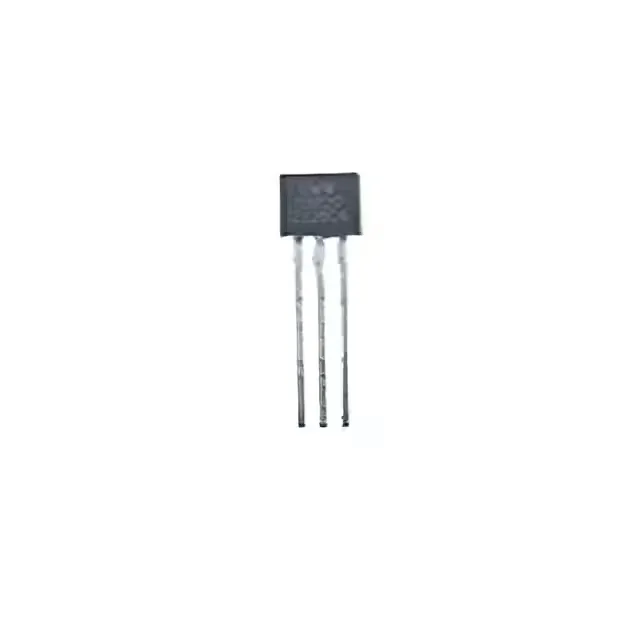
UMW DS18B20
11 B -55 ~ 125C 1-WIRE DIGITAL,
Full Technical Specifications
13 Parameters| Parameter / Attribute | Specification / Value |
|---|---|
| Series | UMW DS18B20 |
| Output type | 1-Wire® |
| Sensor type | Digital, Local |
| Mounting | Through Hole |
| Supply voltage | 2.5V ~ 5.5V |
| Operating temperature | -55°C ~ 125°C |
| Package | Bulk |
| Features | Standby Mode |
| Resolution | 9 b, 10 b, 11 b, 12 b |
| Case | TO-226-3, TO-92-3 (TO-226AA) |
| Test condition | -10°C ~ 70°C |
| Accuracy - highest (Lowest) | ±0.4°C |
| Sensing temperature - local | -55°C ~ 125°C |
Need Stock or a Drop-in Second-Source for DS18B20?
Package: TO-92 / SOIC-8 / uSOP-8 · Pin-compatible replacements with immediate Shenzhen spot stock
The DS18B20 is the temperature sensor of the 1-Wire world - one wire, no calibration, everywhere from industrial probes to aquarium controllers - and it is also the most counterfeited sensor on the market, with a thousand-part study across seventy marketplace vendors finding almost all of it fake. The parts that circulate as DS18B20 are a zoo: near-enough clones, downgraded dies, and hybrids with supercaps instead of EEPROM. What makes the situation workable is that the genuine family is well documented and behaviorally distinguishable: power-up readings, ROM patterns, conversion timing and the marking style all separate the descendants of the original from the imitations - and the programmatic tells cost a bench minute to check.
Verified Pin-Compatible Replacements (3 verified alternatives)
The Documented Sibling in the Same Family Code
Shenzhen Spot Stock (24-48h Dispatch)
A DS18B20-lineage part sharing the same 1-Wire family code (0x28) - software cannot tell them apart - with a lower supply ceiling (up to 3.7V) and a narrower high-accuracy window.
The 3.7V ceiling is the substitution check: on 5V buses the MAX31820 is out of spec where the DS18B20 runs.
The Original Format - Same Socket, Different Math
Shenzhen Spot Stock (24-48h Dispatch)
The DS1820-compatible 9-bit presentation: converts at 12-bit internally but reads out in the old weighted format with the Count-Per-C register that needs a computation for sub-degree resolution.
Same 1-Wire envelope; same TO-92/SO-8 sockets.
The Genuine Part, Ordered Honestly
Shenzhen Spot Stock (24-48h Dispatch)
The current production part with the genuine lineage behind the 0x28 family code: 9-12 bit resolution, 0.5C accuracy class over the standard window, 750ms maximum conversion at full resolution.
The full 3.0V to 5.5V window and genuine EEPROM-backed alarm thresholds.
Buyer & Quality Checklist for Sourcing Alternatives
- Read the family code first: 0x28 = DS18B20-class (9-12 bit), 0x10 = DS18S20 (old weighted format plus Count-Per-C math), 0x22 = DS1822 econo. Firmware branches on it; hardware sockets usually do not care.
- The documented counterfeit screen, cheapest first: power-up reading (85C genuine, 25C a known clone fingerprint), ROM pattern (genuine follows 28-xx-xx-xx-xx-00-00-xx with known exceptions), conversion time at 12-bit (genuine around 580-615ms on the classic die; 11ms, 30ms and other values are clone fingerprints), EEPROM persistence, and printed-versus-lasered markings.
- Do not probe with undocumented function codes to identify chips - published identification work notes this can permanently brick sensors. Stick to read-only checks.
- Parasitic-power mode is where clones fail loudest: genuine parts convert reliably from the bus line, many fakes brown out. If a design uses parasitic power, that test alone is the screen.
- DS18S20 in a DS18B20 socket: physically fine, mathematically different. Code reading raw registers without checking the family code produces half-resolution-looking data, not garbage - the subtle kind of wrong.
- The probes around the sensor matter as much as the die: waterproof-probe assemblies vary in potting and cable quality, and a genuine sensor in a bad probe reads worse than a clone in a good one. Test the assembly, not just the chip.
Frequently Asked Technical Questions
Q: How do I tell a genuine DS18B20 from a fake?
A: Read-only checks: power-up reading (85C genuine, 25C is a clone fingerprint), ROM pattern, 12-bit conversion time (about 580-615ms genuine on the classic die), EEPROM persistence and lasered vs printed markings. Published open research documents the fingerprint library - never use undocumented opcodes to probe.
Q: Is MAX31820 a drop-in for DS18B20?
A: Software-wise yes - same 0x28 family code, indistinguishable on the bus. Electrically it caps at 3.7V supply and a narrower accuracy window: fine on 3.3V systems, out of spec on 5V buses.
Q: Can I use a DS18S20 where a DS18B20 was specified?
A: Same socket, different data format: the 18S20 presents the old 9-bit weighted output (family code 0x10) requiring the Count-Per-C computation. Firmware must branch on family code, or the temperature reads coarse.