Active production — what it means for your BOM line
The AD8063ARZ carries an Active lifecycle status from Analog Devices, so it remains a current-production part suitable for both new designs and ongoing builds. ROHS3 compliance is confirmed, which covers the full RoHS exemption set including lead in high-melt-temperature solder — relevant for the 8-SOIC package's reflow profile.
320 MHz bandwidth and 650 V/µs slew rate — the signal-chain ceiling
The -3 dB bandwidth of 320 MHz sets the small-signal flatness window — for a gain-of-2 configuration the closed-loop bandwidth drops to roughly half that figure, so budget the actual stage gain when estimating the usable passband. The 650 V/µs slew rate defines the large-signal response: a 2 V peak-to-peak output step slews in about 3 ns, which keeps the amplifier linear well into the tens-of-MHz range for video or ADC driver applications. Rail-to-rail output swing means the output can reach within millivolts of each supply rail under light loads — useful when the amplifier drives an ADC input that needs the full 2.7 V to 8 V span without headroom loss.
Supply range, temperature grade, and package reworkability
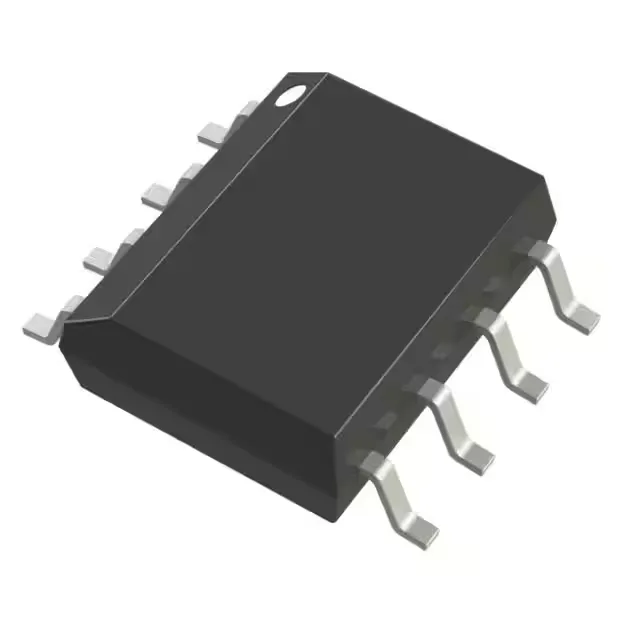
Operating from a single 2.7 V to 8 V supply span, this amplifier works off a standard 3.3 V or 5 V rail without a split supply — the voltage feedback topology keeps the common-mode input range centred. The -40°C to +85°C industrial temperature grade covers most factory-floor and outdoor telecom enclosures. The 8-SOIC (0.154-inch body width) package is a rework-friendly footprint — the 1.27 mm pitch leaves room for a fine-tip iron or hot-air nozzle without bridging adjacent pins. Pin 1 is clearly marked on the package top, so orientation is unambiguous under a bench scope. The tube delivery means the parts arrive in an anti-static tube, not a reel; for automated pick-and-place the tube nests into a standard feeder.
How the AD8063ARZ compares with the AD8027ARZ
The AD8063ARZ delivers 320 MHz bandwidth and 650 V/µs slew rate, while the AD8027ARZ is spec'd at 190 MHz and 100 V/µs. If the BOM was originally designed around the AD8027ARZ, the AD8063ARZ will drop into the same footprint and supply rails (both run from 2.7 V to 8 V) but offers roughly 1.7× the bandwidth and 6.5× the slew rate — a direct swap that preserves the pinout while raising the dynamic performance ceiling.