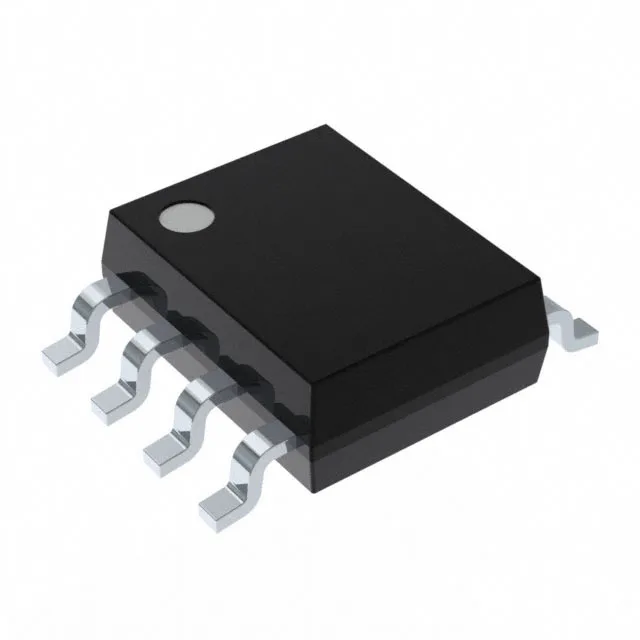
DS1302Z+T&R - Analog Devices Inc./Maxim Integrated
IC RTC CLK/CALENDAR SER 8SOIC
Full Technical Specifications
13 Parameters| Parameter / Attribute | Specification / Value |
|---|---|
| Type | Clock/Calendar |
| Mounting | Surface Mount |
| Supply voltage | 2V ~ 5.5V |
| Voltage - supply, battery | 2V ~ 5.5V |
| Current - timekeeping | 0.3µA ~ 1µA @ 2V ~ 5V |
| Interface | 3-Wire Serial |
| Operating temperature | 0°C ~ 70°C |
| Package | Tape & Reel (TR) Cut Tape (CT) |
| Features | Leap Year, NVSRAM, Trickle-Charger |
| Date format | YY-MM-DD-dd |
| Memory size | 31B |
| Time format | HH:MM:SS (12/24 hr) |
| Case | 8-SOIC (0.154\", 3.90mm Width) |
Need Stock or a Drop-in Second-Source for DS1302Z+T&R?
Package: DIP-8 / SOIC-8 · Pin-compatible replacements with immediate Shenzhen spot stock
The DS1302 is the 3-wire real-time clock of a generation of meters, timers and industrial controllers: a half-SPI interface (CE, SCLK, I/O), a 32.768kHz crystal on pins 2 and 3, 31 bytes of scratchpad RAM - and, uniquely in its family, programmable trickle-charge circuitry for a rechargeable backup on its VCC1 pin. It shares the 8-pin DIP body with the I2C RTCs (DS1307, DS3231) and nothing else: the pins are reshuffled, the protocol is different, and the backup-battery rules run opposite between the two worlds. The socket cannot tell any of them apart - which is exactly why repairs in the settings-memory era keep getting this one wrong.
Verified Pin-Compatible Replacements (2 verified alternatives)
The I2C Sibling - Same Body, Different Everything
Shenzhen Spot Stock (24-48h Dispatch)
The I2C clock of the same era: standard two-wire bus at the fixed address, a programmable square-wave output on pin 7 - and a completely different pin assignment (powers at 8 and 3, crystal at 1 and 2, bus at 5 and 6).
Both run 2.5V to 5.5V and both keep time through power loss; the pins doing it do not match.
The Precision TCXO Route
Shenzhen Spot Stock (24-48h Dispatch)
The modern answer where accuracy matters: an integrated TCXO holds minutes-per-month drift inside seconds-per-month territory, with temperature compensation the crystal-and-capacitor pair of the 1302 was never designed for.
Own pinout and package (16-pin SOIC); the I2C bus returns at the modern register map.
Buyer & Quality Checklist for Sourcing Alternatives
- The 8-pin body is shared and the pins are not: DS1302 is VCC2/X1/X2/GND/CE/I-O/SCLK/VCC1 against the DS1307 X1/X2/VBAT/GND/SDA/SCL/SQW/VCC. Identifying either by position - or by the socket it sits in - is the first error of this family.
- The backup rules invert: the DS1302 has a programmable trickle charger for a rechargeable backup (supercap or rechargeable cell) on pin 8; the DS1307 must receive a non-rechargeable cell with no charge path. A charger aimed at a CR2032 is a small hazard; a rechargeable on the 1307 sits flat forever.
- The trickle charger is a register, not a default: it is configured (typically off from the factory) by command - a replaced DS1302 whose settings were never written keeps time until the first power cut and then stops.
- Protocols do not translate: the 1302 speaks command-byte 3-wire with CE framing, the I2C parts answer a fixed address. No wiring adapter makes one behave as the other; the firmware changes or nothing does.
- Accuracy is bounded by the crystal pair on all of these older parts (minutes per month at best): where timestamps feed billing, audit or sequences, the TCXO class (DS3231) is the design move - with its own rework and firmware.
- The scratchpad RAM is firmware-visible state: 31 bytes on the 1302, 56 on the 1307 - programs that park state there lose it across any family move, even a well-rewired one.
Frequently Asked Technical Questions
Q: Can a DS1307 replace a DS1302?
A: No. Same DIP-8 footprint, different pin assignment and different protocol (I2C against 3-wire with command framing) - and the battery design inverts: the DS1302 trickle-charges a rechargeable backup, the DS1307 must not receive a charge path at all.
Q: What is the DS1302 pinout?
A: Pin 1 primary supply (VCC2), pins 2 and 3 the 32.768kHz crystal, pin 4 ground, pin 5 CE (reset), pin 6 the bidirectional data line, pin 7 the serial clock, pin 8 the backup supply (VCC1) with the trickle charger.
Q: Why does my RTC lose time or die when the power goes off?
A: The backup domain first: on the DS1302 confirm the trickle charger is enabled for whatever cell or supercap is fitted, on the DS1307 confirm the cell is fresh and nothing charges it. Then the crystal and its load capacitors - and remember these older parts legitimately drift minutes per month.