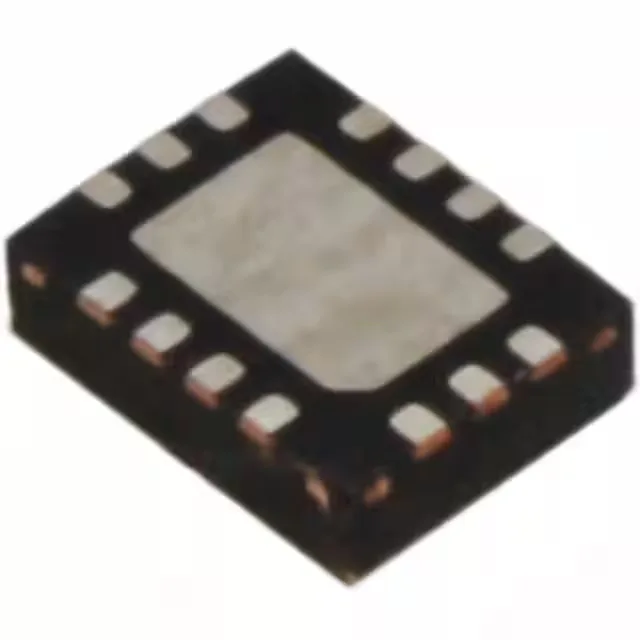
MEMS resonator replaces the quartz blank
The ASEMDLV-LR-T3 is a MEMS-based XO — the resonator is a Pure Silicon™ silicon microstructure rather than a crystal blank, which eliminates the shock-vibration drift that plagues quartz in harsh deployments. LVDS output at up to 400 MHz makes this suitable for clock distribution in high-speed digital boards where LVPECL or HCSL swing is excessive or where the receiving serializer needs a low-swing differential pair.
Frequency options and what ±25ppm means in context
The available frequencies cluster into two groups: 25 MHz through 200 MHz on Output 2, and 100 MHz through 400 MHz on Output 1 — covering the most commonSerializer/Phy clock frequencies and the USB/PCIe reference tiers.
14-VFQFN exposed pad — layout and thermal notes
The 3.20mm × 2.50mm body with a 0.90mm seated height sits in a 14-pin VFQFN with an exposed pad — the pad must be tied to the ground plane under the device for both mechanical retention and thermal relief; no thermal via under the paddle will push the junction temperature above the rating at 38mA supply current. The Enable/Disable function allows the part to drop from 38mA active to 23mA disabled — on a board with multiple clock domains, gating unused oscillators reduces total board current, though the residual 23mA in shutdown means the part is not a true zero-power disable.
Supply rail and current budget
Operating range is 2.25V to 3.6V — the lower bound is set by the LVDS common-mode requirement, not by the MEMS resonator drive level, so a 2.5V rail is acceptable but a 3.3V rail is the more common deployment since it aligns with most serializer/Phy supply domains. At 38mA typical supply current the device dissipates roughly 125 mW at 3.3V — in a sealed enclosure with no airflow, verify the local temperature rise does not push the ambient above 85°C at the oscillator location.
The part is in normal production and supported for new design-in. Confirm the Tape & Reel packaging option matches your assembly pick-and-place requirement.