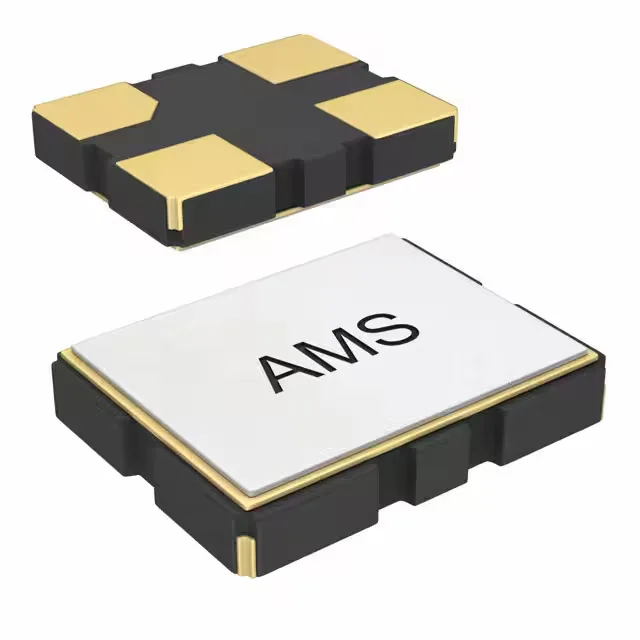
Active XO at 7.3728 MHz — the serial-communications timing sweet spot
The ASE-7.3728MHZ-LR-T: The 7.3728 MHz frequency is not arbitrary — it divides cleanly into standard UART baud rates and is a common secondary crystal frequency in MSP430, PIC, and AVR-based designs that need fractional baud division without a PLL stage. This is a standard CMOS XO, not a MEMS oscillator, built around a crystal resonator as the base element.
3.3 V supply drops directly onto the 3.3 V rail
The 3.3 V nominal supply matches the I/O voltage of most embedded MCUs and SoCs in this performance class — no additional LDO stage is required, and the CMOS output swings rail-to-rail at the host logic level. In active mode the oscillator draws up to 7 mA; when disabled, draw drops to 10 µA maximum, so a host MCU can gate the supply in deep-sleep states without wasting the 7 mA idle current.
±25ppm frequency stability — adequate for UART and embedded control
For UART at 9600–115200 baud this is well within the ±1.5% tolerance most UART receivers accept without framing errors. It is not tight enough for USB or precision real-time clock references, but it sits comfortably inside the window for general embedded timing, sensor sampling clocks, and motor-control PWM carrier frequencies.
Compact 4-SMD no-lead package for pick-and-place assembly
The no-lead (QFN-style) terminations mean the thermal profile is benign for reflow assembly; hand-soldering with a hot-air tool is feasible given the pad size, though paste stenciling is the standard production approach. Supplied on tape and reel for high-volume SMT pick-and-place.