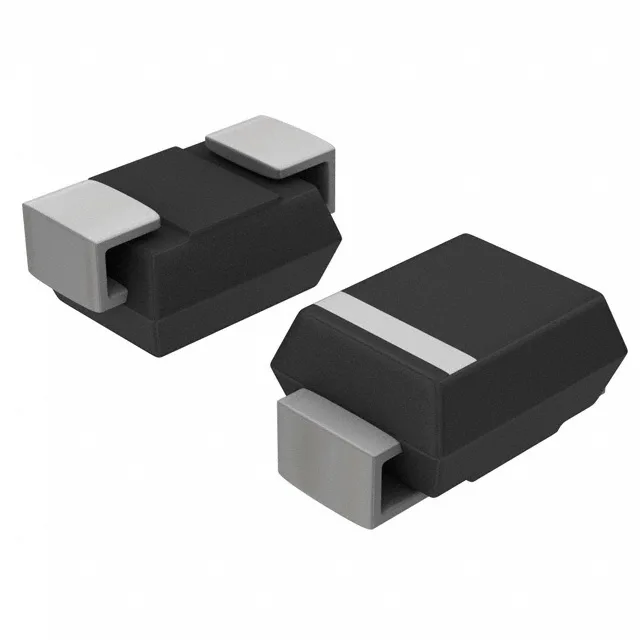
What 43 V standoff means for the protected rail
The YAGEO 5.0SMDJ43A/TR13 is a unidirectional Zener-based TVS diode rated at 43 V typical reverse standoff voltage — the unclamped rail the protected circuit operates at continuously without the device conducting. That 69.4 V clamping ceiling is what the downstream load actually sees during an event — the lower the ceiling relative to the rated withstand of the protected circuitry, the better the protection margin.
5 kW peak pulse — transient energy budget
The 5000 W peak pulse rating (10/1000 µs waveform) sets the device's energy absorption ceiling in the transient event — a lightning-induced surge or inductive kickback that dumps more energy than 5 kW into the diode will push it past its thermal limit and into failure. For this reason the peak pulse current of 72.1 A and the peak pulse power of 5000 W are the two numbers to check against the threat profile of the end equipment, not just the nominal standoff voltage.
SMC packaging and SMT assembly
The unidirectional polarity of the A-suffix variant means the cathode connects toward the rail to be protected; reversing the orientation eliminates the clamping function.