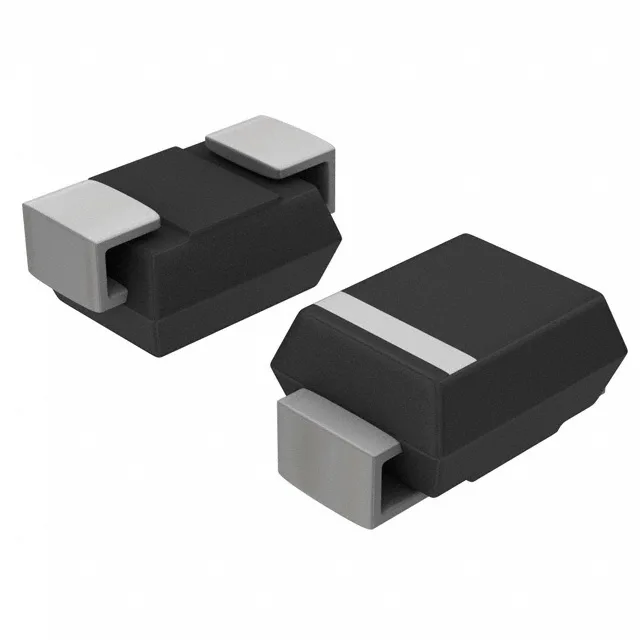
Surge clamp for DC rails and signal lines
The 1.5SMC10A/TR7: It clamps transients at 14.5V maximum and handles 104.8A peak pulse current, making it a fit for protecting 8.55V DC rails — typical in 12V automotive or industrial supply lines — against load-dump and surge events. Housed in a DO-214AB (SMC) surface-mount package, the part operates from -55°C to 150°C junction temperature, covering under-hood and outdoor enclosure environments. The wide temperature range means the clamping behaviour stays within spec across cold cranking and hot soak conditions.
What the ratings mean on the bench
For a 12V nominal bus, this provides margin above the normal operating level. The 14.5V clamp voltage (V_C) at 104.8A peak pulse current is the voltage the protected circuitry sees during a surge — downstream components must survive at least that peak. Real-world transients (e.g., ISO 7637-2 pulses) have different durations and shapes; derate the power capability for longer pulse widths per the datasheet curve. The unidirectional configuration means it only clamps positive transients relative to ground — reverse polarity protection requires a separate diode or a bidirectional part. Package is DO-214AB (SMC), a standard footprint shared across the 1.5SMC family. The SMC body is larger than the SMA/SMB siblings, which gives better thermal dissipation for the 1500W rating.