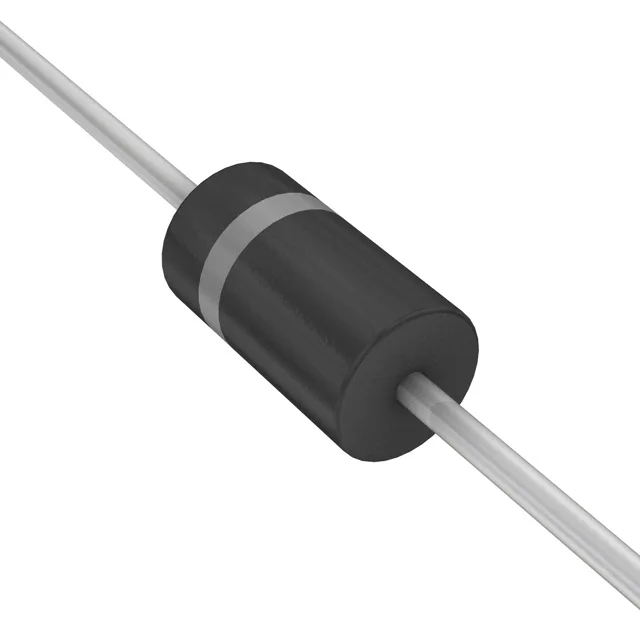
1.5 kW peak pulse power in an automotive-grade axial package
The 1.5KE75A-AT/B: It clamps transients at 103 V maximum when the surge current hits 14.8 A, and its 64.1 V reverse standoff voltage means it stays out of the way during normal 48 V or 60 V bus operation. This is an automotive-grade part (AEC-Q101 qualified), so the silicon is screened for the -55 °C to 150 °C junction temperature range typical of under-hood and chassis-mounted electronics.
Clamping voltage and breakdown margin
The minimum breakdown voltage is 71.3 V, giving a roughly 7 V guard band above the 64.1 V standoff rating. That margin absorbs steady-state rail ripple without the diode conducting, while still triggering well before a 103 V clamp — a 31.7 V window from standoff to clamp that protects downstream silicon rated for, say, 80 V or 100 V. Because it is a unidirectional Zener-type TVS (single channel), it clamps only one polarity. The other polarity is a forward-biased diode drop — about 1 V at high current — so the circuit must handle that asymmetry or pair it with a bidirectional device if the line sees both positive and negative transients.
Package and board integration
The DO-201AA (DO-27) axial-lead package is a through-hole form factor that handles the 1.5 kW pulse without the thermal constraints of a smaller surface-mount body. The lead spacing and body diameter are standard for this power class, so the PCB footprint is well established — no surprises for a rework or manual assembly line. The 14.8 A peak pulse current at the 10/1000 µs waveform confirms it is sized for transient energy, not continuous fault current.