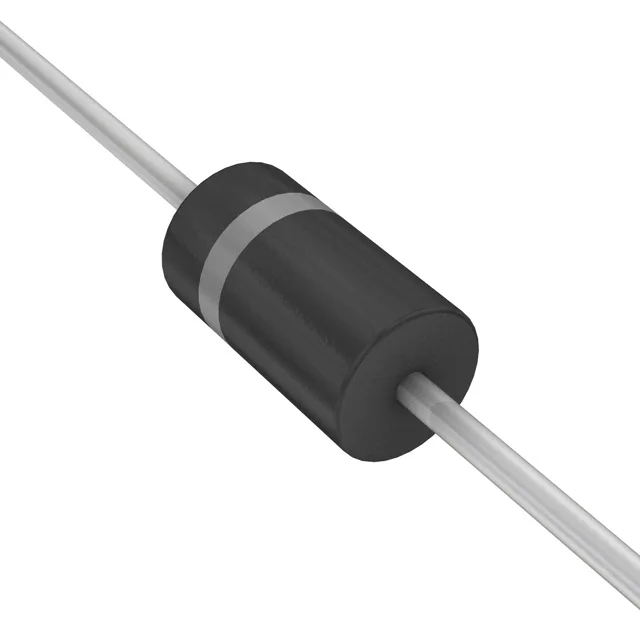
What it clamps and where it fits
The 1.5KE62CA/B: When the line spikes above 58.9 V (the minimum breakdown), the device starts conducting; at 85 V it clamps the surge hard, passing up to 17.9 A of the 10/1000 µs pulse. That 1500 W peak pulse rating means it handles a single high-energy transient — think an inductive kick from a relay or a lightning-coupled surge on a field cable — without failing short. The DO-201AA axial package (also known as DO-27) is the standard through-hole form factor for this power class. On a repair bench or in a production board, it replaces any 1.5KE62CA in the same footprint — orientation is symmetric because it is bidirectional, so you cannot install it backwards.
Ratings that decide the fit
On a nominal 48 V bus (battery or telecom), this gives 5 V of headroom before the TVS starts leaking. The breakdown window from 58.9 V to roughly 65 V (typical) is where the device transitions from blocking to clamping. Clamping at 85 V means the protected circuit must survive that voltage for the duration of the surge. If the downstream components are rated for 100 V or more, this TVS provides adequate protection. The 17.9 A peak pulse current is the maximum surge the diode can sink at the 10/1000 µs waveform — a longer pulse or a higher current risks exceeding the 1500 W limit. The through-hole axial body dissipates heat through the leads into the PCB copper; keep the trace width adequate for the surge current. Use it on control circuits, sensor supplies, or communication lines where the energy is bounded.