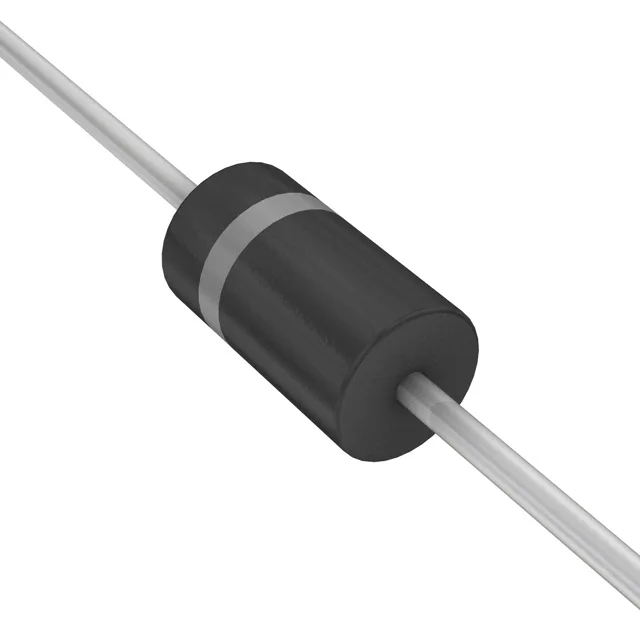
The 1.5KE51CA/B: Its 70.1 V clamping voltage at 21.7 A peak pulse current (10/1000 µs waveform) defines the voltage the protected circuitry must survive — a 48.5 V minimum breakdown threshold means it starts conducting just above the working voltage, leaving a ~5 V guard band before full clamp. Rated -55°C to 150°C junction temperature, it handles the thermal cycling of outdoor or under-hood environments without derating at the extremes.
Housed in the DO-201AA (DO-27) axial-lead package, the 1.5KE51CA/B requires a 1.1 mm diameter hole on a 0.100-inch pitch lead spacing. The through-hole body dissipates surge energy into the PCB copper and surrounding air — no thermal pad or heatsink is needed for the 1500 W peak rating, but the trace width between the TVS and the protected node should carry the 21.7 A pulse without fusing. The DO-201 footprint is standard across the 1.5KE family, so a single board layout accepts any voltage variant from 6.8 V to 440 V. No power line protection (per the spec) means this device is intended for secondary-side DC rails or signal lines, not AC mains — the clamping voltage is too tight for the let-through energy of a mains transient.