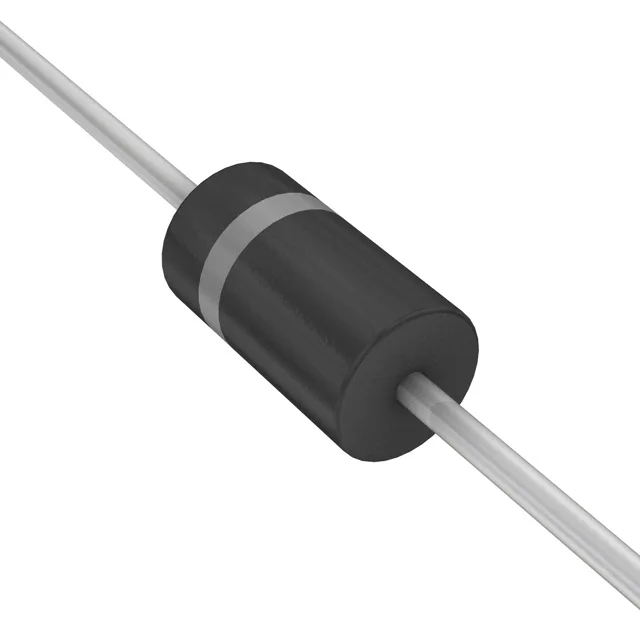
This is the headline rating that governs its ability to clamp a surge — a 30.5 A peak pulse current at the clamping voltage of 49.9 V means it can absorb a substantial energy spike before the silicon reaches its thermal limit. The reverse standoff voltage is 30.8 V, meaning the device will not conduct appreciably below that rail voltage. These three thresholds define the protection window: the circuit's normal operating rail must stay below 30.8 V, and the downstream components must survive a 49.9 V clamp. Housed in a DO-201AA (DO-27) axial-lead through-hole package, the 1.5KE36A/B is a standard-format TVS for board-level or point-to-point wiring. The junction operates from -55°C to 150°C, covering the full industrial and automotive temperature envelope without derating concerns at the extremes.
Unidirectional protection for a single DC rail
This variant is a unidirectional suppressor — one channel, anode to ground, cathode to the protected rail. It clamps positive transients above the breakdown voltage and forward-conducts on negative excursions like a standard diode. The single-channel orientation is the right choice for a DC bus where the polarity is fixed; a bidirectional version would be specified for AC signal lines or floating supplies. The part does not carry a power-line protection designation, which means it is intended for signal-line or low-power DC rail protection rather than mains AC input stages. For a 24 VDC sensor supply or a 28 V avionics bus, the 30.8 V standoff leaves margin above the nominal rail while clamping well below the typical 60 V breakdown of downstream DC-DC converters.
The YAGEO 1.5KE36A/B carries an active product status. The base product number is 1.5KE36, and the suffix A/B indicates the standard tolerance bin.