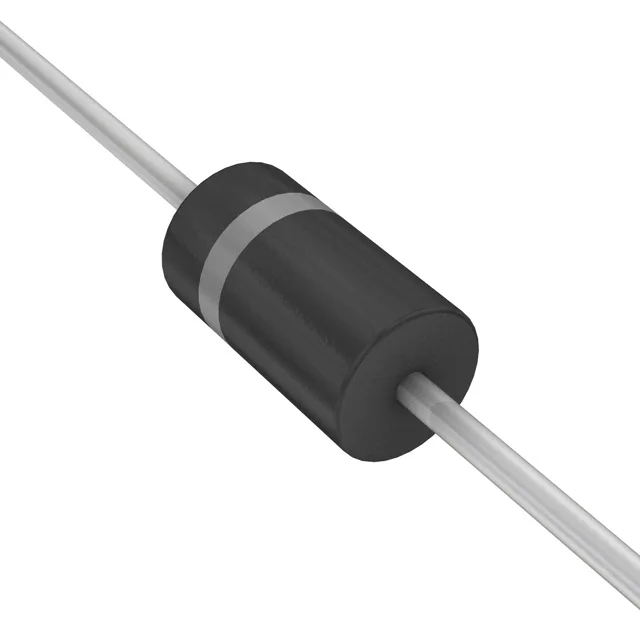
Clamping voltage and the 300V rail it protects
The 1.5KE350A/B: Its 300V reverse standoff voltage means it sits across a 300V DC bus without conducting in normal operation — the leakage stays below the microamp range until a transient pushes the line above the 332V minimum breakdown threshold. At that point the device clamps the surge to 482V maximum, shunting 3.2A of peak pulse current through the DO-201 junction. The 482V clamp ceiling is the number that matters for downstream component selection — any semiconductor on that 300V rail must have a Vds or Vce rating above 482V to survive a clamped surge. The 1500W rating assumes a 10/1000µs double-exponential pulse; shorter transients (8/20µs) allow higher peak current, but the 10/1000µs figure is the standard telecom and industrial benchmark.
Active production and sourcing posture
The 1.5KE series is a standard JEDEC-registered outline, so multiple manufacturers offer pin-compatible parts;.
Temperature range and board-fit note
The DO-201AA axial body requires a 1.0 mm to 1.3 mm diameter hole in the PCB; the cathode band is marked on the body. No power-line protection feature — this is a unidirectional Zener TVS, so it clamps only one polarity; a bidirectional variant would be needed for AC-coupled lines.