Protection window: standoff, breakdown, and clamp
The 1.5KE30A/B: This unidirectional Zener TVS diode has a 25.6 V reverse standoff voltage — the DC rail it protects must stay below this level under normal operation. That 15.8 V window between standoff and clamp defines the transient headroom: a 24 V nominal rail with 5 % tolerance sits safely below 25.6 V, and a surge that drives the line to 41.4 V is clamped before it reaches downstream silicon rated for, say, 45 V.
1500 W peak pulse — what the rating means for real surges
The 1500 W peak pulse power is specified for a 10/1000 µs exponential waveform — the standard telecom surge shape. For shorter pulses (e.g. 8/20 µs from an ESD or lightning strike), the peak current capability is higher because the energy per pulse is lower. The DO-201 axial package dissipates this energy through the lead wires into the PCB copper; a 1 oz copper pad on each side of the board improves thermal spreading during repetitive surges.
Through-hole DO-201 — board integration and temperature range
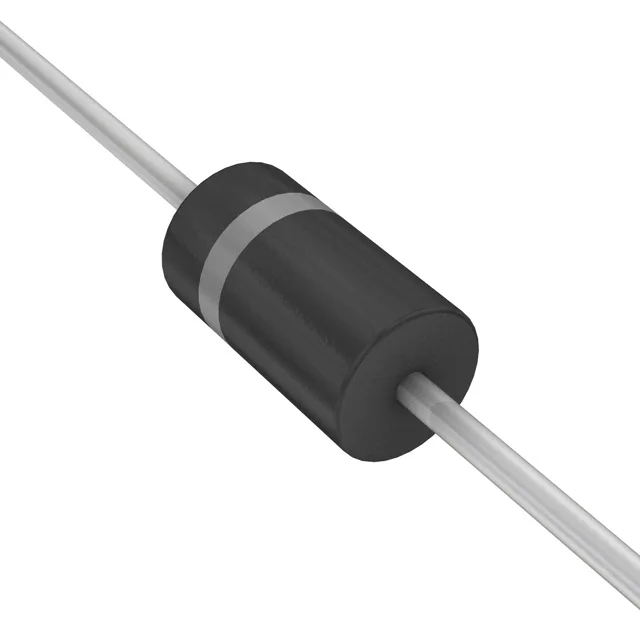
The DO-201AA (DO-27) axial package measures about 9.1 mm body length with 0.96 mm diameter leads — standard for hand-insertion or wave-solder assembly.