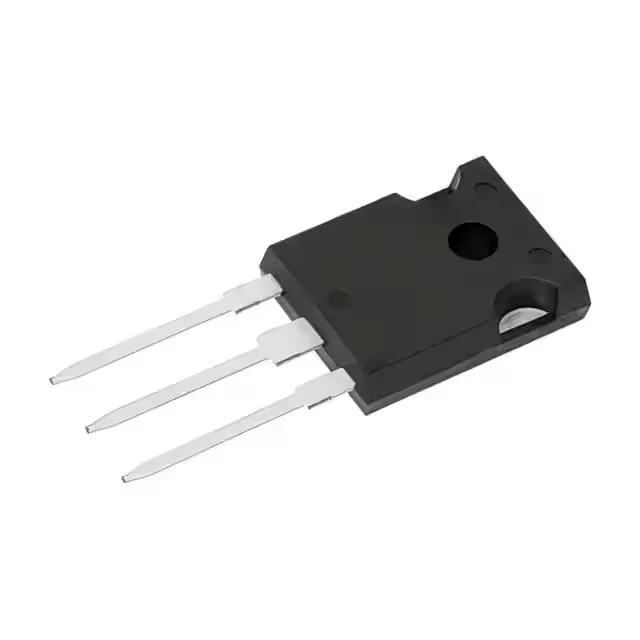
Active production — what it means for a BOM line
The VX80M100PW-M3/P: For a design that already qualifies this dual common-cathode Schottky in a TO-247-3 footprint, the supply channel is the standard authorized-distribution route, not surplus or last-time-buy inventory. AEC-Q101 qualification means the rectifier has passed the full automotive stress battery: high-temperature reverse bias, temperature cycling, and ESD robustness per the JEDEC-based automotive discrete standard. The -40°C to 175°C junction range covers under-hood ambient and oil-immersed transmission environments.
Each Schottky die in the common-cathode pair is rated 40 A average rectified current (Io). At that current the forward drop is 840 mV max — so the per-diode conduction loss at full load is about 34 W. In a TO-247AD package with the tab soldered to a heatsink, the junction-to-case thermal path keeps the die below 175°C if the heatsink is sized for the sum of both diodes in the common-cathode configuration. Reverse leakage at the 100 V rated standoff is 600 µA max.
Fast recovery in a trench Schottky — switching edge
The VX80M100PW-M3/P is a Trench Schottky — the fast recovery classification (<500 ns, >200 mA Io) is inherent to the Schottky barrier, not a PiN diode. There is no stored charge to sweep out, so the reverse recovery time is dominated by the junction capacitance discharge. In a 100 V, 40 A boost or flyback stage the switching loss is negligible compared to the conduction loss, but the capacitive turn-on spike into the FET still needs a snubber if the layout inductance is high.