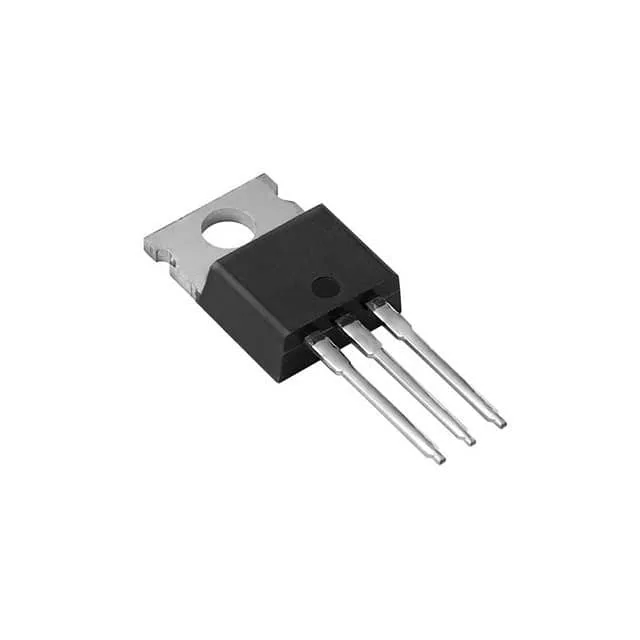
40 A common-cathode Schottky pair for high-temp rectification
The VX40M100C-M3/P is a Vishay Trench Schottky rectifier delivering 20 A per diode (40 A total for the common-cathode pair) at 100 V reverse voltage, housed in a through-hole TO-220-3 (TO-220AB) package. The 760 mV forward drop at 20 A is the conduction loss floor per die — at full rated current each diode dissipates about 15 W, so the tab must be heatsunk to keep junction temperature within the -40 °C to 175 °C operating range. The Fast Recovery spec (≤ 500 ns) confirms this is a trench Schottky structure, not a planar — the trench design lowers the forward drop for a given reverse leakage, which is the trade-off that matters at elevated junction temperatures.
AEC-Q101 qualification and the deployment envelope
This part carries AEC-Q101 automotive qualification — the stress tests (HTSL, TC, H3TRB, PC) are run to Grade 0 or 1 levels, meaning it is released for under-hood or chassis-domain electronics where ambient temperatures regularly exceed 105 °C. The 175 °C rated junction temperature leaves margin for self-heating in a 125 °C engine-bay environment.
Reverse leakage and thermal runaway margin
At 100 V reverse bias the leakage current is 220 µA typical. On a Schottky this doubles roughly every 10-15 °C junction rise — at 150 °C the leakage can exceed 3 mA, contributing additional self-heating. The trench structure mitigates this compared to a planar Schottky of the same voltage class, but the thermal budget should still be calculated across the full load-and-temperature corner. The common-cathode configuration (1 Pair Common Cathode) means the two anodes are independent — this is the standard pinout for a centre-tapped secondary winding or a dual-output boost converter where the cathodes share a common output rail.