Rectifier ratings and what they mean for the BOM
The VS-KBPC604PBF is a single-phase bridge rectifier rated for 400 V peak reverse voltage and 6 A average rectified output current — the headline numbers that govern its place in a DC bus supply. The 400 V PRV means it safely blocks the reverse half-cycle on a 240 VAC line (peak ~340 V) with margin, while the 6 A average sets the continuous current the bridge can deliver into a capacitive or resistive load without exceeding the junction temperature limit. Forward voltage is specified at 1.2 V maximum at 3 A — this is the conduction loss per diode pair at half the rated current. At full 6 A load, the forward drop will be higher; budget the total dissipation (2 × Vf × Iavg) against the D-72 package's thermal impedance to the board or heatsink. The 10 µA reverse leakage at rated 400 V is a room-temperature figure; leakage doubles with every 10 °C rise in junction temperature, so at 125 °C TJ the standby loss may be non-negligible in a lightly loaded supply. The 150 °C TJ limit is the hard stop; the thermal design must keep TJ below that at the worst-case ambient plus self-heating. For a 6 A load in a 50 °C enclosure, the heatsink or PCB copper area must hold the temperature rise to under 100 °C.
Package and board-fit — D-72 through-hole
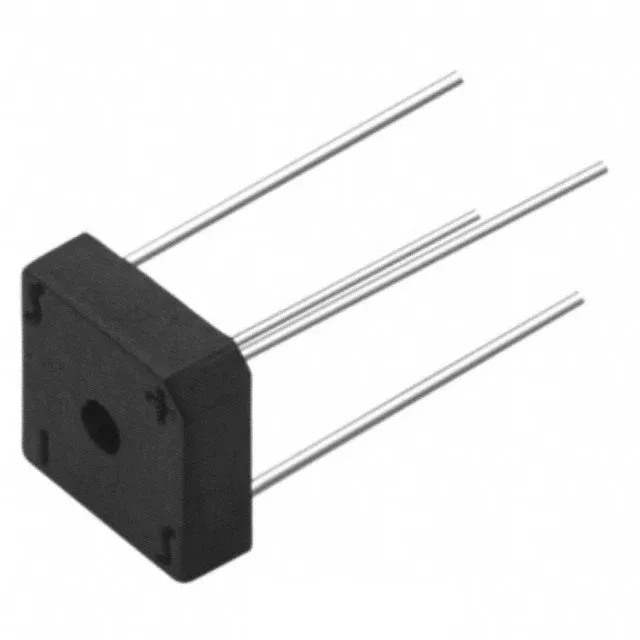
The D-72 is a 4-Square through-hole package with four leads arranged in a square pattern — the AC input terminals and the DC output terminals are opposite each other. The hole pattern and lead spacing are standard for this Vishay KBPC6 series; the PCB footprint should match the manufacturer's recommended pad layout to avoid mechanical stress on the solder joints during thermal cycling.