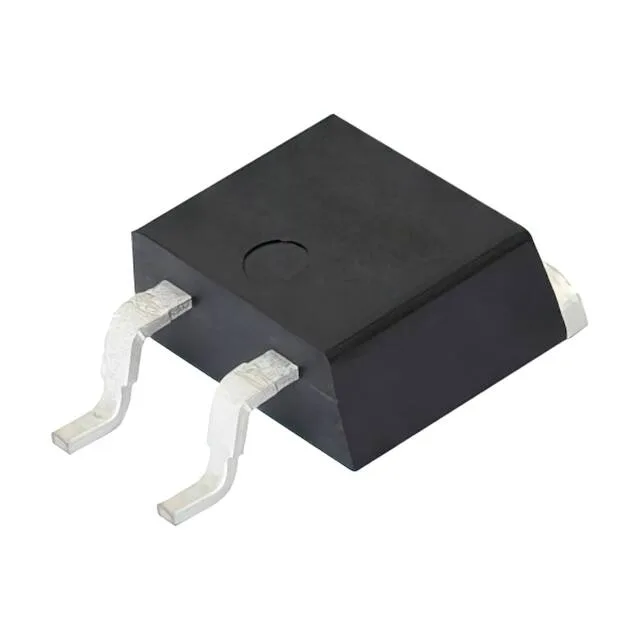
Traction inverter output rectifier — 600 V blocking, 30 A forward, 41 ns recovery
The VS-E5TX3006S2LHM3 is a 600 V, 30 A rated fast-recovery epitaxial diode from Vishay's FRED Pt G5 series, qualified to AEC-Q101 for automotive powertrain and chassis applications. The 41 ns typical reverse recovery time (trr) sets the switching loss in a hard-switched bridge leg — at a 20 kHz PWM carrier, the recovery charge dominates the turn-off energy, and this diode's soft-recovery characteristic limits the voltage overshoot across the complementary switch. The 2.1 V forward drop at 30 A produces 63 W conduction loss — a 2 oz copper pad on a four-layer board with thermal vias to the inner planes is the minimum thermal management for continuous operation above 85°C ambient.
AEC-Q101 qualification and the PPAP trail
The part carries AEC-Q101 qualification as part of the FRED Pt G5 series — this is the automotive discrete semiconductor stress test: high-temperature reverse bias (HTRB), temperature cycling, and solder-joint reliability are documented in the PPAP package. The OEM auditor will ask for the PPAP level (typically PPAP Level 3 for a safety-related ECU); Vishay provides the qualification summary and the PCN notification channel for any process change.
Reverse leakage and the thermal derating decision
The 20 µA reverse leakage at 600 V is specified at 25°C junction — this doubles approximately every 10°C, so at a 150°C junction the leakage is in the 200–300 µA range. In a 30 A circuit the off-state loss is still below 200 mW, but in a high-impedance node (e.g., a bootstrap supply) the leakage may pull down the bias rail if the upstream source impedance is above 10 kΩ. The fast-recovery speed classification (≤500 ns, >200 mA) tells the designer this is a soft-recovery diode, not an ultrafast or SiC Schottky. The turn-off di/dt must be controlled with a gate resistor in the companion MOSFET — a di/dt above 200 A/µs can trigger the diode's snap-off and cause parasitic ringing on the switching node.