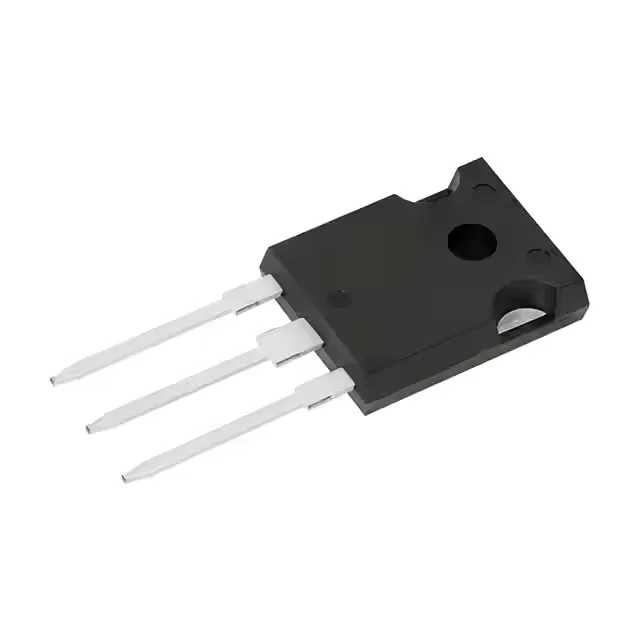
Active production — what it means for the BOM
The VS-C5PW6006LHN3 is listed as Active by Vishay, so it remains a current-production line item for new builds and sustaining orders alike. No last-time-buy window to track, no risk of a sudden EOL notice on the next PCN cycle — this part is a stable BOM entry for the foreseeable future. It carries ROHS3 compliance, which covers the full RoHS exemption set including lead in high-temperature solder (exemption 7(c)-I). That means it passes the material declaration audit for automotive and industrial assemblies without a waiver request.
30 A per diode, 600 V — where the rating lands
Each diode in the common-cathode pair is rated for 30 A average rectified current at a junction temperature up to 175 °C. The 600 V DC reverse voltage gives headroom for a 400 V DC bus with margin for switching transients — typical in a 3-phase PFC stage or a high-voltage DC link snubber. Forward drop is specified at 2.5 V maximum when carrying 30 A. That is a conduction loss of 75 W per diode at full rated current — the TO-247AD package's large copper tab is designed to sink that into a heatsink or baseplate. The junction-to-case thermal path is the limiting factor in a continuous-duty design.
39 ns reverse recovery — the switching edge
A 39 ns typical reverse recovery time places this in the ultrafast class, well inside the <500 ns bracket. For a 100 kHz hard-switched PFC, the recovery charge is low enough that the MOSFET's turn-on loss dominates the switching loss budget — the diode is not the bottleneck. The FRED Pt® Gen 5 process uses platinum diffusion to control the minority-carrier lifetime. The result is a soft recovery characteristic — the di/dt at turn-off is gradual enough to avoid the ringing and EMI that a snappy recovery diode would inject into the gate drive loop.
Automotive grade and package reality
AEC-Q101 qualification means the part has passed the full suite of automotive stress tests: HTRB, H3TRB, temperature cycling, and power cycling. The -55 °C to +175 °C junction range covers under-hood ambient plus self-heating — the 175 °C max is the absolute limit, not a recommended continuous operating point for a 30 A load. The TO-247-3 through-hole package (supplier device package TO-247AD) is a standard footprint for high-power through-hole assembly. The three leads are the anode, cathode, and common cathode — the centre pin is the common cathode tab, which also serves as the primary heat path. Wave solder or selective solder profiles for a 2.4 mm thick lead frame apply; no special reflow profile needed.