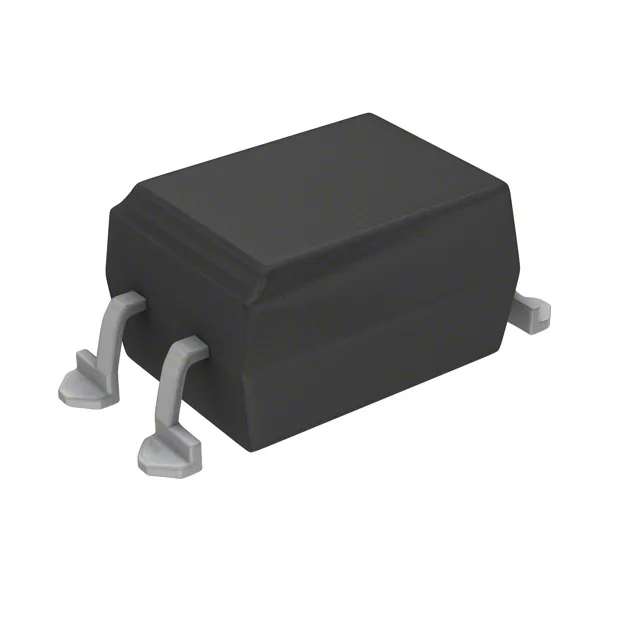
Phototriac optocoupler for AC load switching
The Vishay VOT8121AB-VT1 is a single-channel phototriac optocoupler designed to drive a Triac or SCR for AC load control. Its output is a Triac rated for 800 V off-state voltage, with a minimum static dV/dt of 1 kV/µs to resist false triggering on noisy mains. The part provides 5300 Vrms isolation between input and output, backed by CQC, cUL, UL, and VDE safety approvals. It operates from -55°C to 110°C, suiting industrial motor drives, solid-state relays, and AC power controllers where galvanic isolation is required.
No zero-crossing — random-phase switching
This device has no zero-crossing circuit, meaning the Triac output turns on immediately when the LED current exceeds the 10 mA maximum trigger threshold. That makes it a random-phase driver, suitable for phase-angle control (dimmer, heater) and for applications where the load must switch on at any point in the AC cycle. If your design requires zero-crossing switching to reduce inrush or EMI, you would look at a different variant in the VOT8121 family.
Trigger and hold characteristics
The LED forward voltage is 1.2 V typical, with a maximum DC forward current of 50 mA. The LED trigger current (Ift) is 10 mA maximum, which defines the input drive requirement. Once triggered, the Triac holds conduction with a typical hold current of 400 µA, and the on-state RMS current rating is 100 mA. These ratings set the minimum load current needed to keep the Triac latched and the maximum load the optocoupler can directly drive without an external power Triac.
Housed in a 4-SMD gull wing package (supplier device package 4-SMD), this part is surface-mount ready. The gull wing leads provide good visual solder-joint inspection.
It is ROHS3 compliant. The safety approvals (CQC, cUL, UL, VDE) are already in place, which simplifies regulatory submissions for equipment sold in China, North America, and Europe.