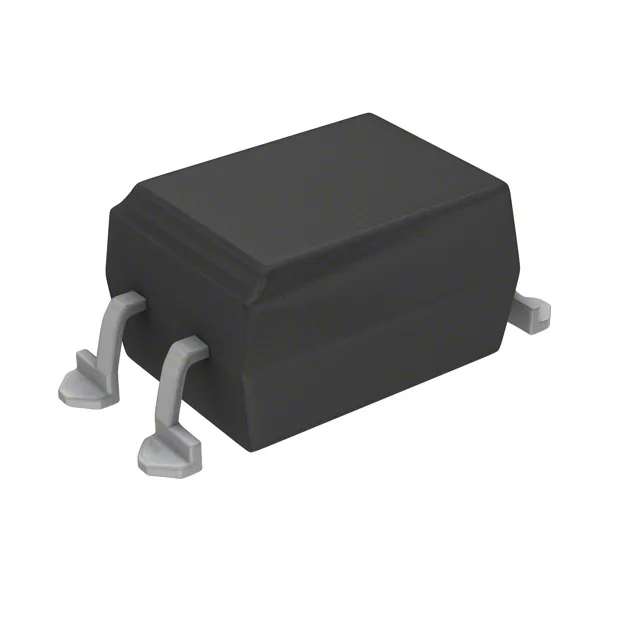
What the 1 kV/µs dV/dt rating means for inductive loads
The VOT8121AB-T1 guarantees a minimum static dV/dt of 1 kV/µs. For a triac output, this is the slew rate the device can withstand on the off-state voltage without commutating falsely — critical when driving an inductive load such as a contactor coil, solenoid valve, or small AC motor where the line voltage is chopped by a triac or relay elsewhere on the same phase. The 800 V off-state rating lets the part block the peak of a 277 VAC line (390 Vpk) with margin for transients. The 5300 Vrms isolation satisfies reinforced insulation requirements per UL/VDE for mains-referenced control circuits.
No zero-crossing — random-phase switching flexibility
This phototriac has no zero-crossing circuit, meaning the output turns on immediately when the LED current exceeds the 10 mA maximum Ift. That enables phase-angle dimming or soft-start for incandescent lamps, heaters, or universal motors, but generates higher inrush and EMI at the switch-on point compared to a zero-crossing part.
Active production, tape-and-reel packaging
Approvals and temperature range
The device is approved by CQC, cUL, UL, and VDE — a standard safety-agency set for AC-mains isolation. The typical forward voltage is 1.2 V with a maximum DC forward current of 50 mA.