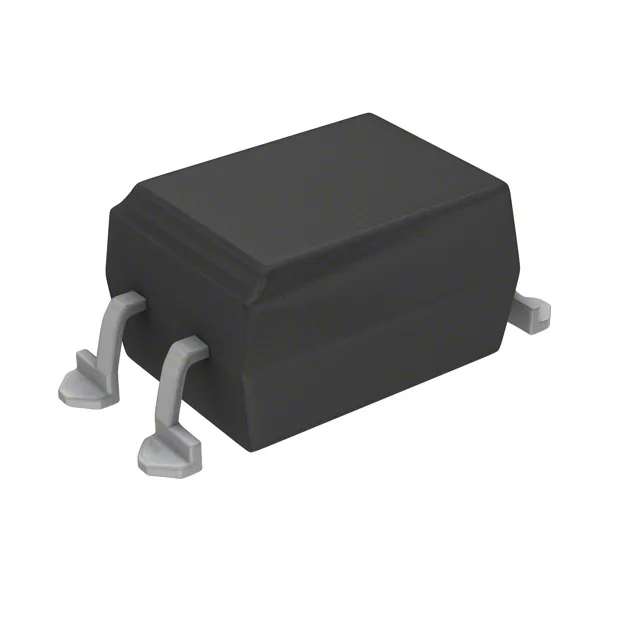
800 V off-state, 5300 Vrms isolation — a phototriac for industrial AC switching
The Vishay VOT8121AB is a single-channel phototriac optocoupler designed to switch AC loads from a low-voltage logic or microcontroller signal. Its 800 V off-state voltage rating and 5300 Vrms isolation make it suitable for driving resistive or inductive loads in motor controls, solenoid valves, lighting ballasts, and solid-state relay front ends where galvanic isolation between the control side and the AC mains is required. The part comes in a 4-SMD Gull Wing package for surface-mount assembly and carries approvals from CQC, cUL, UL, and VDE, covering most global safety certification needs.
No zero-crossing — random-phase switching for dimming and soft-start
The VOT8121AB has no internal zero-crossing circuit, meaning the triac output fires immediately when the LED current exceeds the 10 mA maximum trigger threshold, regardless of the AC line phase. This random-phase behaviour is essential for phase-angle dimming of incandescent or LED lamps, soft-start of motors, and any application where the turn-on point must be controlled. For simple on/off switching of resistive loads, a zero-crossing variant would reduce conducted EMI, but this part intentionally leaves that decision to the designer.
1 kV/µs minimum dV/dt — noise immunity on the AC line
A static dV/dt rating of 1 kV/µs minimum means the phototriac will not falsely trigger when subjected to fast voltage transients — the kind generated by relay contact bounce, motor commutation, or nearby lightning surges on the AC mains. This is a critical parameter for industrial environments where the triac must stay off until the LED is deliberately driven. The 400 µA typical holding current ensures the triac latches on once triggered and drops out cleanly when the load current falls below that threshold near the AC zero crossing.
Active lifecycle — no end-of-life watch for new BOMs
It is ROHS3 compliant.