Automotive-grade isolation for signal and control
The Vishay VOMA617A-8X001T is a single-channel phototransistor optocoupler designed for automotive and industrial applications where galvanic isolation and reliability under harsh conditions are required. Rated for 3750Vrms isolation, this part provides safe signal transfer between high-voltage and low-voltage domains, with a maximum output voltage of 80V and output current capability of 50mA per channel.
The current transfer ratio (CTR) is specified at 130% minimum and 260% maximum at a forward current of 5mA. This bin (the '-8' suffix) gives designers a predictable LED drive current range: at 5mA input, the output transistor can sink between 6.5mA and 13mA. That margin absorbs LED degradation over temperature and lifetime, important for automotive 15-year service targets. Typical turn-on time is 4.9µs and turn-off time is 3.3µs, with rise and fall times of 2.3µs and 3.2µs respectively. These are adequate for low-speed signal isolation — think status feedback, fault detection, or PWM gate drive at frequencies below 50 kHz. For faster switching, a logic-output optocoupler would be needed. Vce saturation is 400mV maximum, which keeps the output voltage drop low when the transistor is fully on — important for maintaining logic-level thresholds on the receiving side.
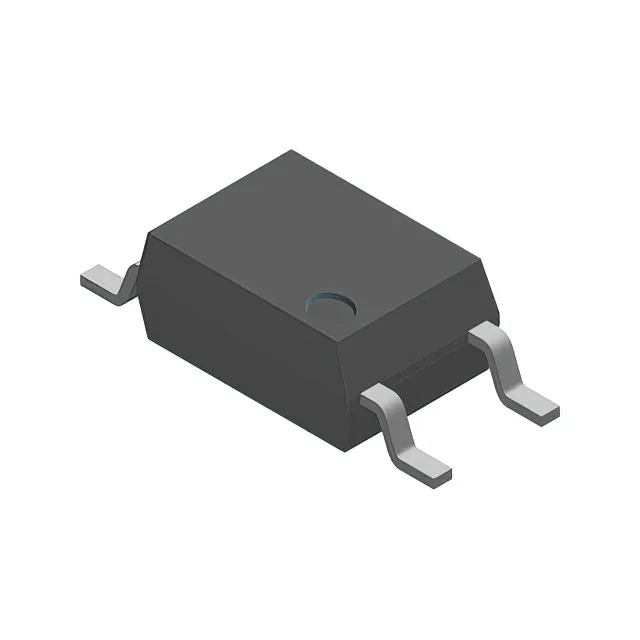
Housed in a 4-SMD gull wing package (4-SOP supplier device package), it is a surface-mount component suited for automated assembly. The gull-wing leads provide good visual solder-joint inspection access. Reflow profile follows standard MSL guidelines — no special handling beyond normal moisture sensitivity precautions.
Lifecycle and supply continuity
For BOM planning: the AEC-Q101 qualification and Active status make this a low-risk choice for automotive and industrial designs that need a qualified, stable supply of phototransistor optocouplers.