5000Vrms isolation and CTR range
The VOL628A: That isolation voltage qualifies it for reinforced insulation in mains-connected circuits — think AC line monitoring, motor drive feedback, or industrial PLC digital inputs where the field side and logic side must be galvanically separated. Its current transfer ratio spans 50% to 600% at 1 mA forward current. The wide spread means the input LED drive must be sized for the 50% minimum to guarantee the output transistor saturates across all temperature and aging conditions. At 1 mA forward, the output can sink up to 50 mA continuous per channel.
Package and reflow fit
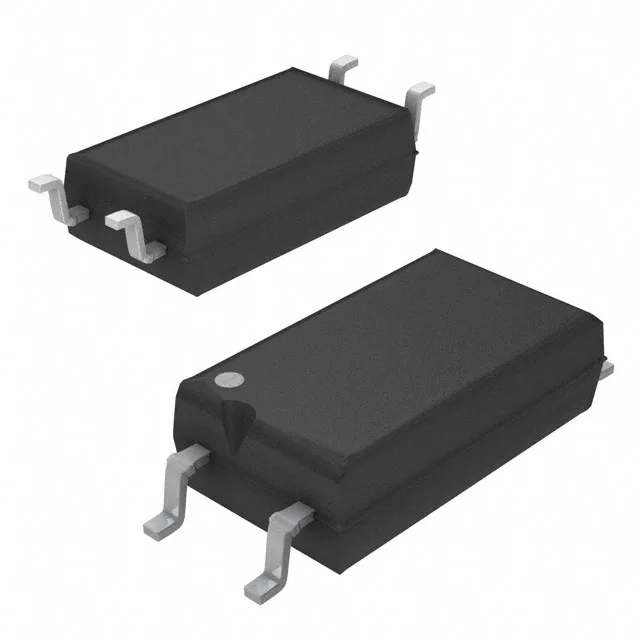
The gull wing leads provide good coplanarity and self-centering during reflow — no tombstoning risk on a well-profiled oven. Operating temperature range of -55°C to 110°C covers industrial enclosures and under-hood automotive environments. The 400 mV max Vce saturation at rated current keeps the power dissipation low enough that no external heatsink is needed in most logic-level loads.
Switching speed and drive capability
Rise and fall times are 3.5 µs and 5 µs typical, with turn-on and turn-off times of 6 µs and 5.5 µs. This limits the practical switching frequency to about 10 kHz — fine for relay drivers, DC motor PWM, or sensor debouncing, but not for high-speed data or isolated serial links. The output transistor can handle up to 80 V across its collector-emitter, and the LED forward current max is 60 mA.
The AC and DC input type means the internal LED is back-to-back or has a bridge — the optocoupler conducts regardless of input polarity. This simplifies board layout when the input signal polarity is unknown or can reverse, such as in AC mains detection circuits.