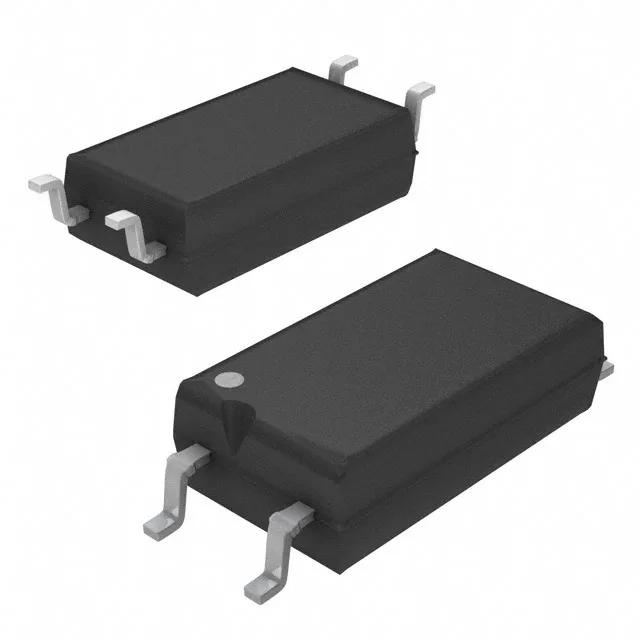
5 kV isolation in a 4-pin SOP footprint
The VOL617A-3T is a single-channel phototransistor optocoupler in a 4-SMD gull wing package (4-SOP supplier package). It provides 5000Vrms of galvanic isolation between a DC input LED and a phototransistor output, which is the standard barrier rating for reinforced insulation in mains-referenced circuits. The gull-wing leads suit the part for surface-mount reflow assembly, and the 4-SOP body keeps the board footprint compact — roughly the same real estate as a small-signal SOT-23 transistor.
CTR range and output drive — what the numbers mean for the BOM
This means the phototransistor collector current will be between 5 mA and 10 mA when the LED is driven with 5 mA — a 1:1 to 2:1 current gain. The 100% floor guarantees the output can saturate a logic input or drive a 5 mA load without over-driving the LED. Output current is rated at 50 mA continuous per channel, and the maximum collector-emitter voltage is 80 V. The 400 mV Vce(sat) at that current means the transistor drops less than half a volt when fully on — useful for driving a downstream gate or relay coil without a buffer transistor. Switching speed is moderate: turn-on time is 6 µs typical, turn-off is 5.5 µs typical, with rise and fall times of 3.5 µs and 5 µs respectively. This limits the part to signaling below about 50 kHz — fine for 50/60 Hz zero-crossing detection, PLC input isolation, or slow digital status feedback, but not for high-speed data or gate-drive applications.