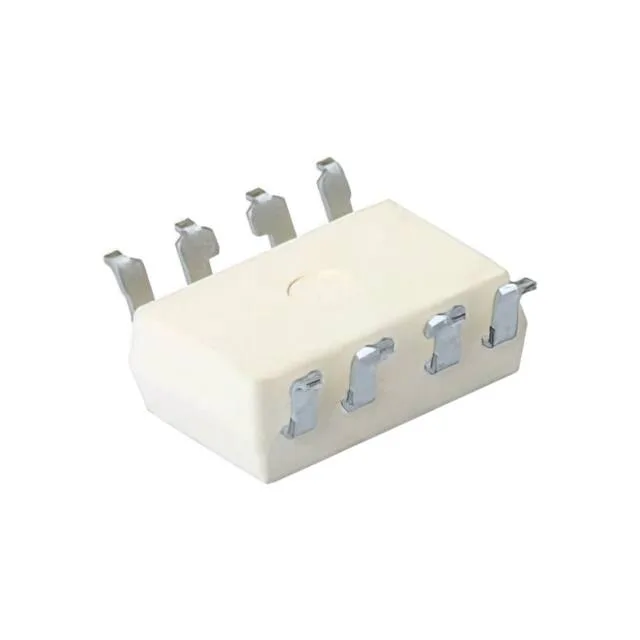
Automotive-grade isolation with linearized photovoltaic output
The Vishay VOA300-DEFG-X017T is a 3-channel optocoupler in the Automotive, AEC-Q102 series, delivering 5300 Vrms isolation between input and output sides. The photovoltaic, linearized output means the photodiode array generates a voltage proportional to the LED drive current without requiring an external bias supply — useful for driving MOSFET or IGBT gates in isolated gate-drive circuits where a clean, floating supply is not available. The AEC-Q102 qualification adds the reliability screening (preconditioning, temperature cycling, HTRB) that tier-1 automotive customers require for PPAP submissions.
Switching speed and drive current trade-offs
Typical rise and fall times are 800 ns each, which sets the practical switching frequency ceiling around 300-400 kHz before the output waveform distorts. The 60 mA maximum forward current (If) and 1.4 V typical forward voltage (Vf) mean the LED side dissipates about 84 mW at full drive — well within the package's thermal budget at 125°C, but the derating curve should be checked for continuous high-duty-cycle operation. The DC input type accepts a steady-state LED current, so no external modulation or carrier frequency is needed — the photovoltaic stack self-generates the gate voltage. This simplifies the drive circuit compared to a transformer-coupled solution, but the 800 ns propagation delay means the part is better suited to fault reporting, status feedback, or slow-switch gate drives than high-frequency PWM stages.
Package, mounting, and sourcing posture
Housed in an 8-SMD Gull Wing package (supplier device package 8-SMD), the part mounts on standard surface-mount pads with a 1.27 mm pitch. The Gull Wing leads provide visual solder-joint inspection access and relieve mechanical stress during thermal cycling — a practical advantage over leadless packages in automotive modules that see frequent temperature swings.