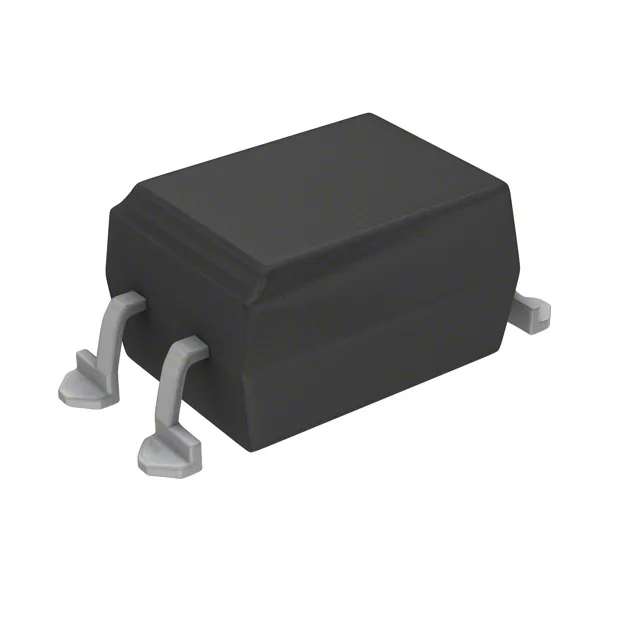
5300 Vrms isolation — what it buys you
The VO617A-4X007T is a single-channel optocoupler from Vishay with a transistor output, rated for 5300 Vrms of galvanic isolation. That isolation voltage covers reinforced insulation requirements in mains-connected industrial controls, motor drives, and power-supply feedback loops. The DC input side drives an infrared LED (typical forward voltage 1.35 V at 5 mA), and the phototransistor on the output side can switch up to 80 V at 50 mA continuous. The current transfer ratio is specified between 160% and 320% at a 5 mA forward current, giving you a predictable gain margin for logic-level translation or isolated switching.
CTR range and switching speed — design decisions
The 160% to 320% CTR range at 5 mA forward current means the output transistor can sink 8 mA to 16 mA with only 5 mA LED drive. That is enough headroom to drive a standard CMOS or TTL input without a buffer. The typical turn-on time is 3 µs and turn-off is 2.3 µs, with rise and fall times both 2 µs. That is adequate for 10 kHz to 20 kHz switching in relay drivers, PLC input modules, or isolated serial interfaces. If you need faster edges, look at a logic-output optocoupler; this part is built for robust isolation at moderate speed.
The 4-SMD gull-wing package (4-SMD, Gull Wing) is a standard footprint that reflows cleanly with a hot-air station or reflow oven. The gull-wing leads are visible for inspection, and the part is small enough that thermal mass is not an issue — it will survive a rework cycle without trouble. The tape-and-reel option (Tape & Reel (TR); Cut Tape (CT)) is the common shipping format for automated assembly; cut tape is available for prototyping.
The 110°C upper limit is below typical automotive under-hood requirements (125°C), but it fits industrial and commercial equipment where the ambient stays under 85°C with some margin. The maximum collector-emitter saturation voltage is 400 mV at the rated output current, so the power dissipation in the output transistor stays low across the temperature range.
The ROHS3 compliance covers the current exemption list, so it is acceptable for European and global markets.