Triac output with zero-crossing — what it means for the load
The VO3063-X017T: The integrated triac output with zero-crossing circuit means the internal switch turns on only near the AC line voltage zero — this minimises inrush current into capacitive or resistive loads like solenoids, heaters, or lamp filaments. The 600 V off-state rating covers 240 VAC line applications with margin for mains transients. Static dV/dt immunity is specified at a minimum of 1.5 kV/µs — this is the key parameter for commutating the triac off without false triggering when driving inductive loads (motors, contactors, transformer primaries). A lower dV/dt rating would risk self-commutation failure; this figure keeps the output latched off through the line zero-crossing. The on-state RMS current is 100 mA max — this drives a medium-power triac gate or a low-power AC load directly. For higher loads, use it as the isolated trigger for an external power triac or SSR.
LED drive and isolation
Forward voltage is 1.2 V typ, and the absolute-max forward current is 60 mA, so a 330 Ω resistor from a 5 V rail keeps the LED well within ratings. Isolation is 5300 Vrms — this is a reinforced-grade isolation barrier suitable for mains-isolated control interfaces, medical equipment per IEC 60601-1 (2 MOPP with proper creepage), or industrial PLC I/O modules where galvanic isolation between field and logic sides is mandatory. Hold current (Ih) is 200 µA typ — the triac output stays latched on as long as the load current exceeds this threshold. Below it, the output turns off at the next zero crossing. This is typical for zero-crossing triac drivers and means the minimum load current should be sized above 200 µA to avoid output chatter.
Package, approvals, and temperature range
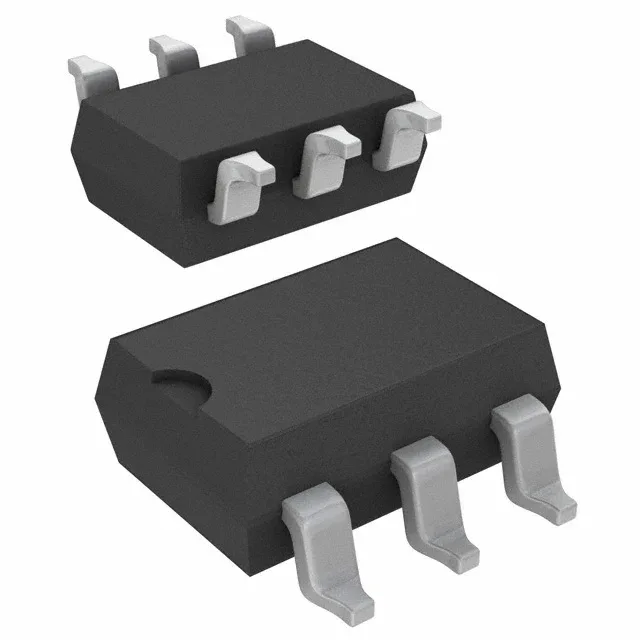
Housed in a 6-SMD gull wing package with a 6-SMD supplier device package designation. The gull-wing leads are suitable for standard reflow soldering and allow visual inspection of the solder joints. Cut Tape is for prototyping or small-run builds. Approved by cUR, UR, and VDE — the VDE mark confirms compliance with IEC 60747-5-5 for reinforced isolation, and the cUR/UR marks cover UL 1577 component recognition for North American installations. The -55°C low end suits cold-start environments like refrigeration or outdoor telecom cabinets.