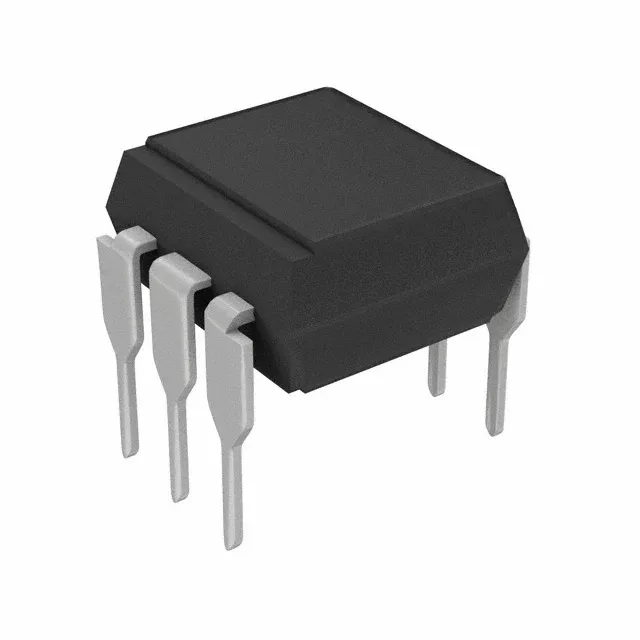
400 V off-state — drives 240 VAC loads with headroom
The Vishay VO3023 is a single-channel optoisolator with a triac output rated for 400 V off-state voltage and 1 A RMS on-state current. The 400 V rating provides margin above the 240 VAC peak of 339 V, handling typical mains transients without commutating the triac. The 1 A RMS on-state covers resistive loads like incandescent lamps, small heaters, and solenoid valves up to ~240 VA. For higher-current loads, the VO3023 can drive an external power triac or SSR.
100 V/µs dV/dt — immunity for inductive switching
Minimum static dV/dt of 100 V/µs means the triac will not falsely trigger from fast voltage spikes on the AC line — a common failure mode when switching motors, contactors, or transformers. This rating is well above the typical 50-60 Hz mains slew rate (less than 1 V/µs), so the margin covers most industrial noise environments.
Non-zero-crossing — phase-angle control enabled
The VO3023 has no zero-cross circuit, so the triac can be triggered at any point in the AC cycle. This allows phase-angle dimming, soft-start, or proportional power control. The trade-off is higher EMI compared to zero-cross types — a snubber across the triac is recommended for inductive loads.
A 3.3 V microcontroller GPIO can drive it through a 390 Ω series resistor without a buffer transistor. The absolute maximum DC forward current is 50 mA, so continuous drive is safe. The 200 µA typical hold current means the triac latches once triggered and does not need a continuous LED signal.
5000 Vrms isolation — safety barrier for mains-isolated control
Reinforced isolation rated at 5000 Vrms separates the low-voltage control side from the line-voltage load side. The 6-DIP package with 0.300" (7.62 mm) pin spacing provides creepage distance suitable for industrial and appliance applications. Approvals from CQC, CSA, cUL, FIMKO, and UL cover North American, European, and Chinese safety standards — no need for separate regional certifications.
The 100°C upper limit is the ambient temperature, not junction — derate the 1 A on-state current above 70°C per the datasheet curve. The through-hole 6-DIP package is wave-solder compatible and can be socketed for field replacement.