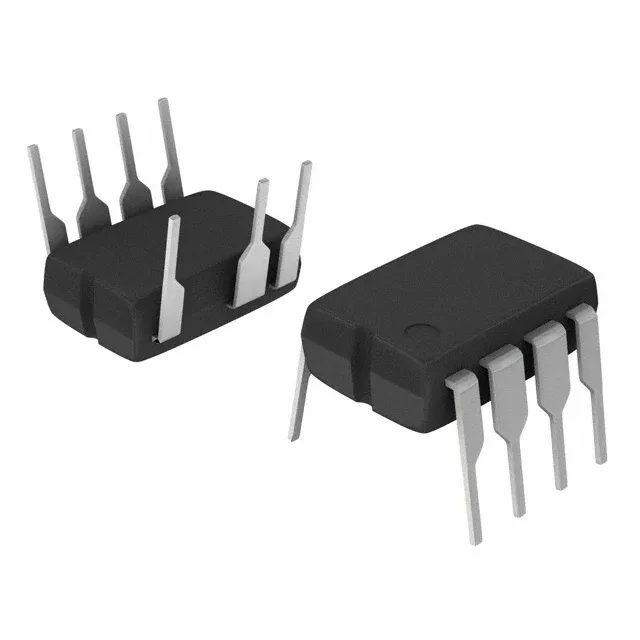
900 mA power triac in an 8-DIP — the load-switching ceiling
The VO2223-X001 is a 1-channel power triac optocoupler from Vishay, rated for 900 mA RMS on-state current and 600 V off-state voltage. That 900 mA figure is the continuous load it can switch through the internal triac — think solenoid valves, small AC fans, or resistive heater elements up to that current. The through-hole 8-DIP package (0.300" pitch, 7 leads) suits prototype boards or production runs where a hand-solderable footprint is preferred over a surface-mount part.
5300 Vrms isolation and 210 V/µs dV/dt — the safety and commutation margins
For a mains-connected load, that isolation protects the low-voltage control circuit from line transients and fault potentials. The static dV/dt immunity is a minimum of 210 V/µs (typical). This is the critical parameter for inductive loads: when the triac commutates off, the voltage across it rises at the line zero-crossing rate. A dV/dt rating below the circuit's natural rise rate can cause the triac to self-trigger and lose control. 210 V/µs covers most resistive and lightly inductive AC loads without an external snubber, but a heavily inductive motor or transformer may still need one. The output does not include a zero-crossing circuit, so the triac can be triggered at any point in the AC cycle. This enables phase-angle control for dimming or soft-start applications, but also means the turn-on transient is a step function — the dV/dt immunity and load inductance govern whether that step causes ringing.
LED drive requirements and temperature range
The input LED requires a forward voltage of 1.3 V typical (max) and a trigger current of 10 mA max to fire the triac. The DC forward current is limited to 50 mA. The hold current (Ih) is 25 mA — the minimum load current required to keep the triac latched once triggered. If the load draws less than 25 mA at the trough of the AC cycle, the triac may drop out and need retriggering every half-cycle.
Active production — no lifecycle concern
The VO2223-X001 is listed as Active by Vishay and is ROHS3 compliant.