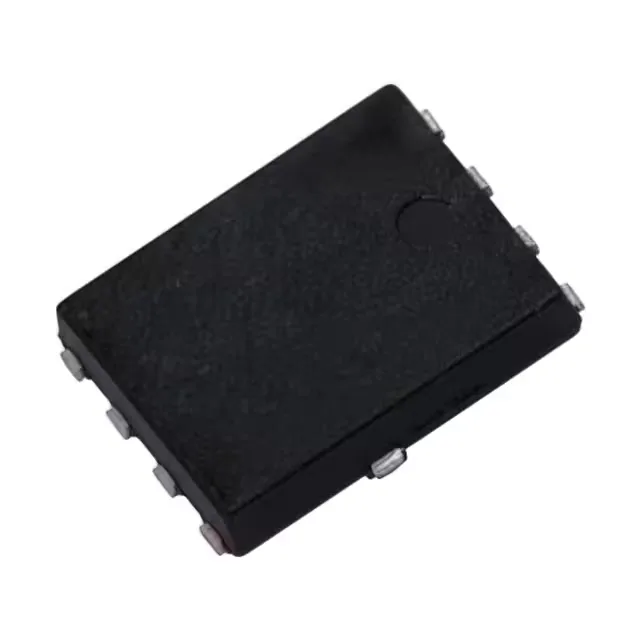
Package and board integration — FlatPAK 5x6
The V15K100C-M3/H comes in the 8-PowerTDFN package, Vishay's FlatPAK (5x6) footprint. The dual-diode common-cathode configuration shares the cathode on the pad, so the PCB copper pour under the part is at the cathode potential. Keep the anode traces clear of the pad to avoid short circuits during reflow.
Automotive qualification — AEC-Q101, not just a marketing claim
The V15K100C-M3/H is listed under the Automotive, AEC-Q101 series. AEC-Q101 is the stress-test qualification standard for automotive discrete semiconductors — it covers temperature cycling, HTRB (high-temperature reverse bias), intermittent operating life, and ESD robustness up to 2 kV HBM. The OEM auditor will expect PPAP documentation (PSW, IMDS, and the AEC-Q101 test report) from the supply chain. Vishay provides these under the standard automotive PPAP flow.
Headline ratings — what 100 V and 4.2 A mean for the BOM
100 V maximum reverse voltage (Vr) is the breakdown rating — it must stay below the peak repetitive reverse voltage in the application. For a 12 V automotive system, a 100 V diode handles the load-dump transient (typically 35-40 V) with margin; for a 24 V truck system, the margin shrinks but still covers the 58 V load-dump spec in ISO 7637-2 pulse 5a. 4.2 A average rectified current per diode (Io) is the DC forward current rating at the reference temperature. In a common-cathode pair used as a center-tap rectifier, the total output current is twice that — 8.4 A — because each diode conducts on alternating half-cycles. The forward voltage is 690 mV typical at 7.5 A per diode, so at full current the conduction loss per diode is about 5.2 W; the thermal pad must keep the junction below 150°C. The fast recovery spec (under 500 ns) is for circuits where reverse recovery charge (Qrr) causes switching loss. In a 100 kHz DC-DC converter, a 500 ns recovery adds about 5% efficiency loss compared to a 50 ns ultrafast diode; for 50/60 Hz rectification, the recovery time is irrelevant.