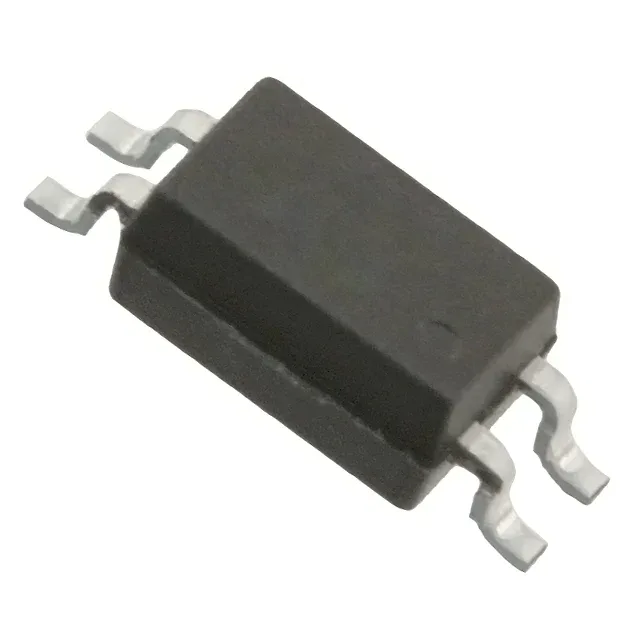
Single-channel optocoupler for isolated signal transfer
The Vishay TCMT1102 is a single-channel, DC-input, transistor-output optocoupler in a 4-SOP surface-mount package.
The current transfer ratio is specified at 63% minimum to 125% maximum, both measured at If = 10 mA. That spread means the output transistor saturates with as little as 6.3 mA collector current for 10 mA in, or as much as 12.5 mA — the designer sizes the pull-up resistor and the input resistor to guarantee saturation across the full CTR window. A 3.3V logic input with a 330 Ω series resistor delivers about 10 mA forward current, which lands squarely in the test condition. Rise and fall times are 5.5 µs and 7 µs typical; turn-on and turn-off times are 9.5 µs and 8.5 µs typical. This part handles 10 kbaud to 100 kbaud serial links cleanly — think UART isolation or slow PLC input filtering. For faster signals like 1 MHz PWM or CAN, look at a digital-output optocoupler with sub-microsecond propagation delay.
Output voltage and current ratings
The output transistor is rated for 70 V maximum collector-emitter voltage and 50 mA continuous output current per channel. That covers 24 V industrial logic rails and 5 V / 3.3 V logic translation with margin. The 300 mV maximum saturation voltage at the test current keeps the on-state voltage drop low enough that the output can drive a standard TTL or CMOS input without an extra pull-up to a higher rail.