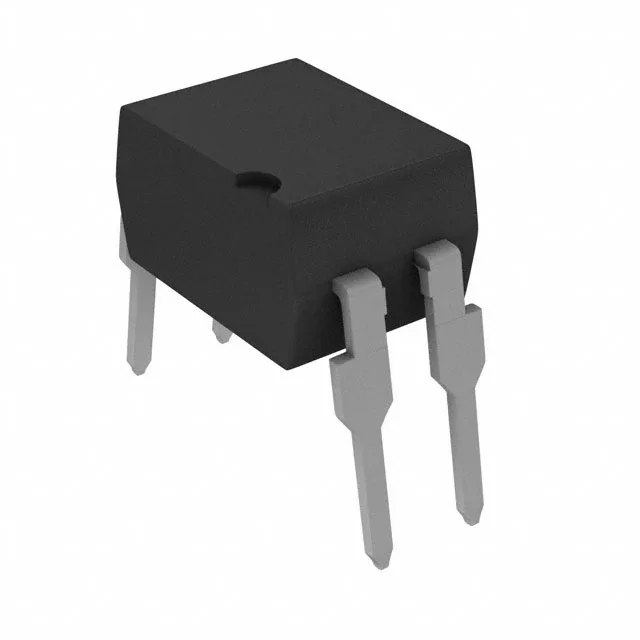
The TCET1106G: That isolation voltage is tested per the 4-DIP package's creepage and clearance — it certifies the part for reinforced insulation in mains-connected circuits where a fault on the primary side must not reach the secondary. With a DC input and a phototransistor output, this is the workhorse topology for logic-level signal isolation, PLC digital inputs, and isolated feedback in switch-mode power supplies.
CTR range and switching speed — the two numbers that decide fit
The current transfer ratio (CTR) is specified as 100% minimum and 300% maximum at If = 5 mA. A 100% floor means the output transistor can sink at least as much current as the LED draws — so a 5 mA LED drive guarantees at least 5 mA of output drive, enough to pull a TTL or CMOS input low through a pull-up resistor. The 300% ceiling tells you the gain spread across temperature and manufacturing; a design that works with a 100% CTR part will saturate the output harder with a 300% unit, but the turn-off time will be slower because of stored base charge. Switching speed is characterised two ways: rise/fall times of 3 µs and 4.7 µs typical, and turn-on/turn-off times of 6 µs and 5 µs typical. These numbers set the practical data rate at roughly 50-100 kbit/s for NRZ signalling — fast enough for 9600 baud serial, slow for CAN or SPI. For PWM dimming or relay drive at a few hundred Hz, the 6 µs turn-on delay is negligible. The 70 V output breakdown and 50 mA continuous output current mean the phototransistor can drive a small relay coil directly or interface to a 24 V industrial logic rail without a level shifter.
Temperature range and package — board-fit constraints
The 4-DIP (0.400-inch, 10.16 mm pitch) through-hole package is a standard 4-pin DIP footprint with 2.54 mm pin spacing — it drops into a socket or solders directly into a plated-through-hole PCB. The 1.25 V typical forward voltage at 5-10 mA LED current is standard for an infrared LED; the 60 mA absolute-maximum forward current gives headroom for pulsed operation above the 5 mA test condition.
Active lifecycle and compliance documentation
The part ships in Tube packaging, the standard through-hole DIP format for pick-and-place or manual assembly. For EU-market shipments, the ROHS3 declaration covers the ten restricted substances including the four phthalates added in the 2015 amendment.