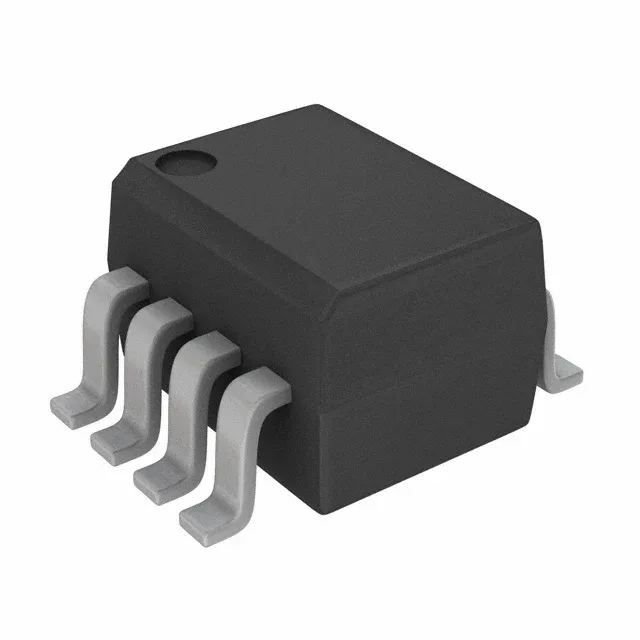
8-SOIC footprint and isolation rating
The SFH6319T comes in an 8-SOIC package (0.154" body width, 3.90 mm) with a 4000 Vrms isolation rating. That 8-pin SOIC footprint is standard for optocouplers in this class — the 4000 Vrms figure tells you the reinforced insulation between the LED and the phototransistor side meets IEC 60950-1 basic isolation requirements for mains-voltage separation. Creepage and clearance across the package body are built into the SOIC-8 leadframe; no external slotting needed on the PCB for most applications.
CTR range — why 500% minimum matters
Current transfer ratio spans 500% to 2600% at a forward current of 1.6 mA. A minimum CTR of 500% means the phototransistor collector current is at least five times the LED drive current — so a 1.6 mA LED pulse yields at least 8 mA on the output side. That is a generous margin for degraded LED output over temperature or lifetime, and it lets you drive the LED at a lower current to save power in battery-operated designs. The wide spread (500% to 2600%) is typical for Darlington-output optocouplers; the base node on this transistor-with-base output gives you access to the base for external biasing or speed-up networks.
Switching speed and output drive
Turn-on time is 600 ns typical, turn-off 1.5 µs typical. That places the SFH6319T in the medium-speed class — fine for 50/60 Hz line synchronisation, relay driver interfaces, or DC bus voltage sensing where the signal bandwidth stays below a few kHz. The 60 mA continuous output per channel and 18 V collector-emitter maximum voltage cover most logic-level and low-power load switching. If you need faster edges, the base access lets you add a base-emitter resistor to sweep stored charge and reduce turn-off time.
Temperature range and compliance
Operating temperature spans -55°C to 100°C, which covers industrial enclosures and outdoor telecom cabinets.