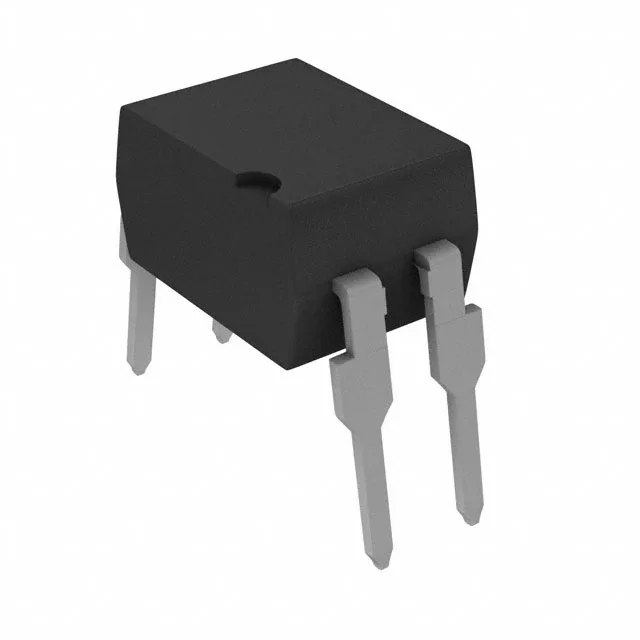
5300Vrms isolation in a 4-DIP through-hole package
The Vishay SFH617A-2 is a single-channel phototransistor optocoupler in a 4-DIP through-hole package, providing 5300Vrms galvanic isolation between a DC input and a transistor output. It is designed for applications requiring signal isolation in industrial control, power supply feedback loops, motor drive interfaces, and medical equipment where the 5300Vrms rating meets reinforced insulation requirements. The part operates over a -55°C to 110°C temperature range, covering most industrial and some automotive under-hood environments without needing a commercial-grade derating.
The current transfer ratio (CTR) is the key parametric for a phototransistor optocoupler — it tells you how much collector current you get for a given LED forward current. The SFH617A-2 guarantees a CTR range of 63% to 125% at a forward current of 10mA. That means with 10mA through the LED, the output transistor can sink at least 6.3mA and up to 12.5mA at the collector, depending on the unit. This bin (the -2 suffix) sits between the -1 (40-80%) and -3 (100-200%) CTR bins in the SFH617A family, giving a middle gain that suits designs where you need consistent saturation margin across temperature and LED aging without over-driving the output. The 70V maximum collector-emitter voltage and 50mA output current per channel give enough headroom for 5V and 12V logic-level interfaces and low-side switching up to a few tens of milliamps.
Switching speed: 2µs rise/fall, 3µs turn-on
That puts the SFH617A-2 in the standard-speed phototransistor class — fine for 10-100 kHz switching power supply feedback, relay driver isolation, and digital signal isolation up to about 100 kbps. For higher-speed applications like isolated SPI or CAN, you would step up to a logic-output optocoupler. The 400mV maximum Vce saturation at the rated forward current ensures the output pulls low enough to drive TTL or CMOS inputs without a pull-up resistor adjustment.
For dual-sourcing flexibility, the SFH617A family includes other CTR bins (-1, -3) in the same 4-DIP pinout, so you can qualify an alternate bin if the -2 goes on allocation — just adjust the pull-up resistor or LED drive current to match the different CTR range.