Active production — no last-time-buy pressure
The K815P: The ROHS3 compliance covers EU and similar markets without exemption-based restrictions.
Darlington output — 600% CTR at 1 mA drive
The Darlington output stage delivers a minimum current transfer ratio of 600% at just 1 mA forward current. That means a 1 mA LED drive produces at least 6 mA at the output — enough to saturate the transistor and switch a 5 V logic input or a 24 V PLC digital input without an external pull-up transistor. The 80 mA continuous output rating handles relay coils and small solenoids directly. Vce saturation is 100 mV max at the rated output current — the transistor drops under 0.1 V when fully on, keeping power dissipation low in the 4-DIP package.
5.3 kVrms isolation — industrial and mains-referenced circuits
The 5300 Vrms isolation rating provides reinforced insulation for separating low-voltage control logic from mains-voltage power circuits. This covers IEC 60950-1 / IEC 62368-1 reinforced insulation requirements for 250 Vrms working voltage. The 4-DIP package with 7.62 mm pin pitch maintains the creepage distance needed for that isolation level across the PCB. Operating temperature spans -40°C to +100°C, covering industrial enclosures and outdoor telecom cabinets without derating at the high end.
Switching speed — 300 µs rise, 250 µs turn-off
Rise time is 300 µs typical; turn-off time is 250 µs typical. This optocoupler is suited for DC signal isolation and low-frequency AC line sensing (50/60 Hz zero-cross detection), not for high-speed data or PWM gate drive above a few hundred hertz. The 300 µs rise means the output takes about 0.3 ms to go from low to high — a 1 kHz square wave would be heavily distorted. Input is DC-coupled — the LED forward voltage is 1.2 V typical with a maximum forward current of 60 mA. A series resistor from the MCU GPIO or PLC output sets the LED current; 1 mA to 10 mA is the practical range for the 600% CTR.
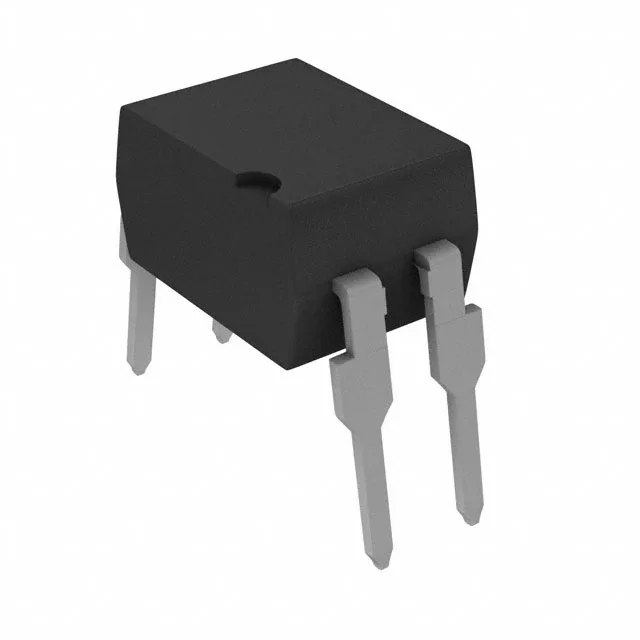
Package and board-fit — 4-DIP through-hole
The supplier device package is 4-DIP. Through-hole mounting means the part inserts into a drilled PCB and is wave-soldered or hand-soldered — no reflow profile needed. The tube packaging protects the leads during handling and storage.