IRFP450LCPBF
Vishay
MOSFET N-CH 500V 14A TO247-3
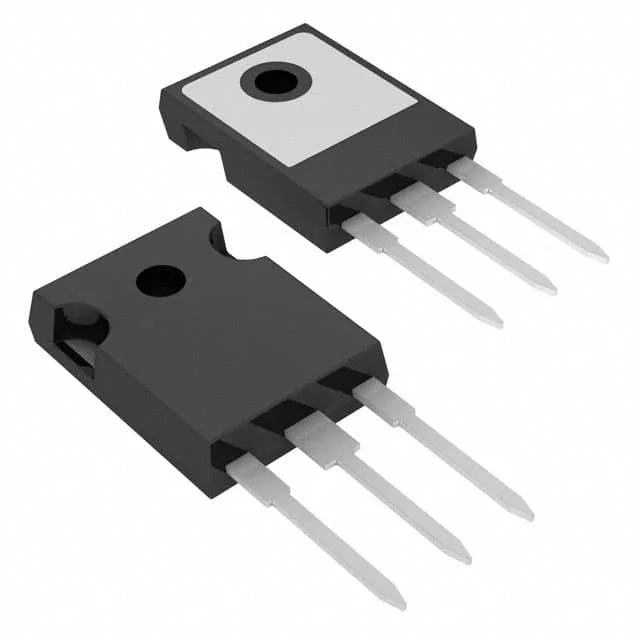
MOQ 1 · Tube · RoHS · EIA-481 · DAP/DDP · T/T
Technical specifications
| Parameter / Attribute | Specification / Value |
|---|---|
| FET type | N-Channel |
| Mounting | Through Hole |
| Drain to source voltage | 500 V |
| Drive voltage (Max rds on, min rds on) | 10V |
| Current - continuous drain (Id) @ 25°C | 14A (Tc) |
| Power dissipation | 190W (Tc) |
| Operating temperature | -55°C ~ 150°C (TJ) |
| Package | Tube |
| Vgs | ±30V |
| Technology | MOSFET (Metal Oxide) |
| Case | TO-247-3 |
| Vgs(th) (Max) @ id | 4V @ 250µA |
| Rds on (Max) @ id, vgs | 400mOhm @ 8.4A, 10V |
| Gate charge (Qg) (Max) @ vgs | 74 nC @ 10 V |
| Input capacitance (Ciss) (Max) @ vds | 2200 pF @ 25 V |
Need Stock or a Drop-in Second-Source for IRFP450LCPBF?
Package: TO-247AC · Pin-compatible replacements with immediate Shenzhen spot stock
The IRFP460 is the 500V TO-247 power MOSFET that repair benches meet in offline inverters, welder power stages, UPS and induction hardware: 500V, 20A, 0.27 ohm, and a pinout that the IRFP250 shares exactly while switching an entirely different voltage class. The substitution game around it is one question asked in the right order: which voltage class does this socket actually switch? The 460 and its 450/462 siblings are 500V parts on a current ladder; the 250 that gets pulled in by memory is a 200V device from battery-side inverter duty - same body, same pins, wrong bus. Add the re-badged-die market and this page pays for itself in one welder repair.
Verified Pin-Compatible Replacements (3 verified alternatives)
The 500V Rung Below
Shenzhen Spot Stock (24-48h Dispatch)
The same 500V class at a lower current: 14A and about 0.4 ohm against the 20A and 0.27 ohm of the 460 - a substitution that works only after the dissipation arithmetic (current squared times resistance) is done at the real load.
Same 500V Vdss, same TO-247 outline and pin order.
The Light-Gate Fast Grade
Shenzhen Spot Stock (24-48h Dispatch)
The same 500V/20A envelope with a lighter gate: about 77nC of gate charge against the 200nC-class standard part, with the A grade sitting between at about 105nC - same socket, faster edges.
Identical ratings envelope; the difference lives in the gate.
The 200V Neighbor - Same Body, Wrong Bus
Shenzhen Spot Stock (24-48h Dispatch)
The part that shares the outline and the family culture but not the class: the IRFP250 is a 200V, 33A, 0.085 ohm device built for 12-48V battery-side inverters - every pin matches and the dielectric does not.
The number that matters: 200V against 500V. In an offline welder or mains inverter bus it dies at the first switching transient, not the first overload.
Buyer & Quality Checklist for Sourcing Alternatives
- Voltage class before anything: the 460/450/462 are 500V parts; the 250 shares their body and pinout at 200V for battery-side inverters. Offline welders, mains inverters and PFC stages need the 500V class regardless of what fits the socket.
- The current ladder trades margin for price: 20A/0.27 ohm (460), 17A/0.35 ohm (462), 14A/0.4 ohm (450). Conduction loss scales with current squared times resistance - grade down only with the load re-measured.
- Gate weight is a real variant axis: plain 460 around 200nC, the A grade near 105nC, the LC near 77nC. The light-gate parts speed up edges and EMI; check the driver and snubber before treating them as free improvements.
- Counterfeit tell at the bench: measure on-resistance and breakdown. A reading near 0.085 ohm is a re-badged 200V-class die; near 0.4 ohm, a 14A-class die under a 460 marking. Legitimate second sources like ISC carry their own branding - fakes wear the original marking on the wrong die.
- In welders and inverters the FET dies with its gate network: the gate resistor and often the driver stage fail first. Replace the device set and the gate parts together, or the fresh FET inherits the fault that killed the old one.
- The TO-247 tab carries the drain, not an isolated flange: mounting hardware, mica and grease are part of the 500V design, and dust across the creepage path is a classic comeback after a field repair.
Frequently Asked Technical Questions
Q: Can I use an IRFP250 in place of an IRFP460?
A: No - they share the TO-247 body and pin order but not the voltage class. The IRFP250 is a 200V device for low-voltage inverters; the IRFP460 is a 500V part for offline and welder duty. The 200V part fails at the first bus transient in mains-side service.
Q: What changes between IRFP460 and IRFP450?
A: Current and on-resistance inside the same 500V class: 20A at 0.27 ohm against 14A at about 0.4 ohm. The 450 substitutes in a 460 socket only after the dissipation is re-checked at the real load current.
Q: How do I spot counterfeit IRFP460 parts?
A: By measurement, not appearance: on-resistance near 0.085 ohm means a rebadged 200V-class die, near 0.4 ohm a 14A-class die. Genuine-class parts read around 0.27 ohm with 500V breakdown - verify before batch fitting a broker lot.