IRF840PBF-BE3
Vishay
MOSFET N-CH 500V 8A TO220AB
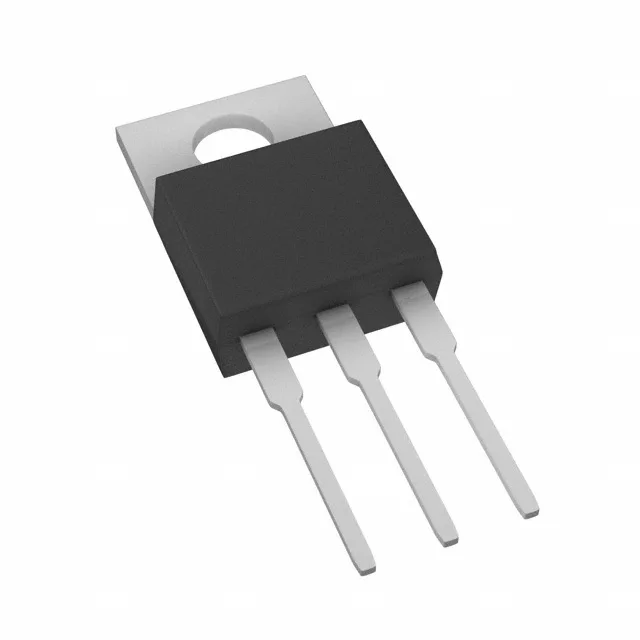
MOQ 1 · Tube · RoHS · EIA-481 · DAP/DDP · T/T
Technical specifications
| Parameter / Attribute | Specification / Value |
|---|---|
| FET type | N-Channel |
| Mounting | Through Hole |
| Drain to source voltage | 500 V |
| Drive voltage (Max rds on, min rds on) | 10V |
| Current - continuous drain (Id) @ 25°C | 8A (Tc) |
| Power dissipation | 125W (Tc) |
| Operating temperature | -55°C ~ 150°C (TJ) |
| Package | Tube |
| Vgs | ±20V |
| Technology | MOSFET (Metal Oxide) |
| Case | TO-220-3 |
| Vgs(th) (Max) @ id | 4V @ 250µA |
| Rds on (Max) @ id, vgs | 850mOhm @ 4.8A, 10V |
| Gate charge (Qg) (Max) @ vgs | 63 nC @ 10 V |
| Input capacitance (Ciss) (Max) @ vds | 1300 pF @ 25 V |
Need Stock or a Drop-in Second-Source for IRF840PBF-BE3?
Package: TO-220AB (IRFI versions: TO-220 FullPak) · Pin-compatible replacements with immediate Shenzhen spot stock
The IRF820/830/840 family is the 500V TO-220 workhorse line of off-line SMPS repair, electronic ballasts and the primary-side switching of a generation of power supplies: same 500V body, same ±20V gates, three current classes - 2.5A at 3 ohms, 4.5A at 1.5 ohms, 8A at 0.85 ohms - plus insulated FullPak variants that trade current for a plastic tab. The substitutions inside the ladder follow one arithmetic (up is free after a gate-charge check, down costs conduction loss), and the drawer trap lives one part number away: the IRFZ44N that sits next to them in every TO-220 bin is a 55-VOLT part from the low-voltage world, and the wrong grab turns a mains supply repair into a fireworks display.
Verified Pin-Compatible Replacements (3 verified alternatives)
The 4.5A Middle Rung
Shenzhen Spot Stock (24-48h Dispatch)
The middle die of the 500V ladder: 4.5A at about 1.5 ohms against the 8A and 0.85 ohms of the 840 - same envelope, a little over half the current and a warmer time at load.
Same 500V Vdss and ±20V gate window.
The 2.5A Bottom Rung for Ballast Duty
Shenzhen Spot Stock (24-48h Dispatch)
The smallest die: 2.5A at about 3 ohms - the original ballast and small-adapter part, where the load genuinely sits in the amp class.
Same 500V class; the gate charge is the low end (about a third of the 840) which is why ballast drivers loved it.
The Insulated Body, At a Price in Current
Shenzhen Spot Stock (24-48h Dispatch)
The fully-isolated versions: the plastic FullPak body removes the mica and the isolation kit from the thermal path - and the insulation costs current class (about 4.6A for the 840 die, 3.1A for the 830).
Same 500V and gate ratings; the difference is mounting and dissipation.
Buyer & Quality Checklist for Sourcing Alternatives
- Voltage class before anything: IRF820/830/840 are all 500V parts for off-line duty; the IRFZ44N that shares their TO-220 bin is 55V and the IRF540N is 100V. Three drawers, three different worlds of rail - read Vdss off the part, never off the shape.
- The ladder arithmetic: 2.5A/3 ohm (820), 4.5A/1.5 ohm (830), 8A/0.85 ohm (840). Up the ladder is free margin electrically; down the ladder is conduction loss in an SMPS or ballast that measured its heatsink around the original.
- Gate charge scales with the die: the 840 asks for roughly 63nC class against a third of that at the 820 - a driver sized for the small part may edge-turn the big one, and a driver sized for the big part drives the small one like a switch. Check the gate drive when crossing rungs.
- The FullPak variants (IRFI prefix) trade current for mounting simplicity: insulated tab, no mica, lower current class (4.6A for the 840 die). The substitution is thermal before it is electrical.
- In ballast and resonant SMPS duty the surrounding network is tuned: gate resistors, snubbers and the drain clamp all expect a given die - a rung change without re-checking edges turns EMI and dv/dt stress into the next failure.
- Counterfeit reading on this ladder: a re-marked lower-class die under an 840 stamping shows up as on-resistance and thermal behavior outside the datasheet curve - curve-trace and load-test the first unit of any broker lot before it joins the drawer.
Frequently Asked Technical Questions
Q: Can an IRF830 replace an IRF840?
A: Same 500V class and footprint, lower current and higher on-resistance: it works only at re-measured load, since the extra loss lands on the heatsink. The reverse - 840 into an 830 socket - is free margin electrically, subject to the gate-charge check.
Q: What is the difference between IRF840 and IRFZ44N?
A: Voltage class: 500V against 55V. Both are TO-220 N-channel MOSFETs that share repair drawers, which is exactly how a mains-side supply gets a low-voltage part fitted - and then explodes. Read the voltage, not the package.
Q: What does the IRFI prefix mean?
A: The insulated FullPak body: the same 500V die in a fully isolated plastic package that removes the mica washer and mounting kit from the thermal path, at the cost of a lower current class (about 4.6A for the 840 die).