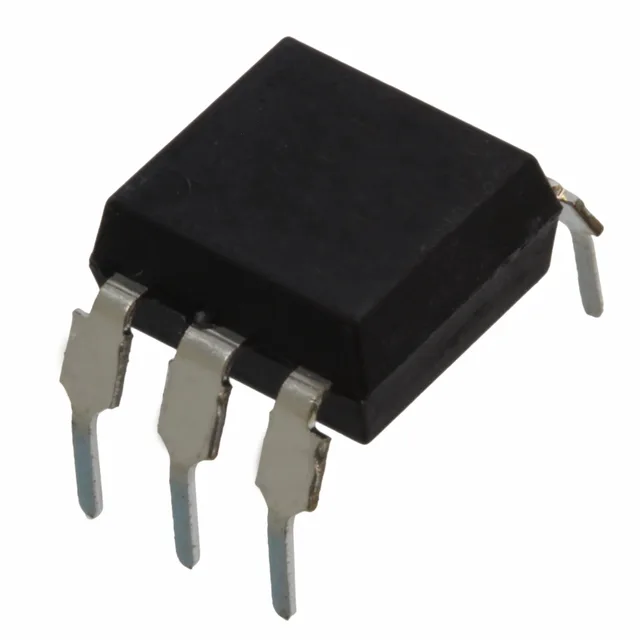
5300Vrms isolation and 600 V off-state — the safety-isolated triac driver
The Vishay IL420-X006 is a single-channel optoisolator with a triac output, designed for isolated AC load control. It provides 5300Vrms of input-to-output isolation, with a 600 V off-state voltage rating and 300 mA maximum on-state RMS current. The output is a non-zero-crossing triac, meaning the trigger can fire at any point in the AC waveform — this enables phase-angle control for dimming or soft-start but also means the designer must account for the 35 µs turn-on time and the 10kV/µs minimum static dV/dt immunity when switching inductive loads.
10kV/µs dV/dt — why it matters for inductive loads
The 10kV/µs minimum static dV/dt rating is the key spec for reliable AC switching. When a triac commutates off at zero current, the reapplied voltage across the device can trigger it back on if the rate of rise is too fast. A 10kV/µs rating gives solid margin for motor, solenoid, and transformer loads where the line voltage snaps back after the current zero crossing. Below this threshold, a snubber network across the triac is usually unnecessary — above it, you still want to keep the PCB layout clean and the load's parasitic inductance controlled.
The IL420-X006 triggers with a maximum LED current of 2 mA (Ift), and the triac holds on with a minimum 500 µA hold current (Ih). The 500 µA hold current means the triac will stay latched for most load currents down to a few tens of milliamps. If the load current drops below the hold threshold at the AC zero crossing, the triac will turn off cleanly.
Through-hole 6-DIP — the board-level fit
The IL420-X006 comes in a 6-DIP through-hole package with a 0.400-inch (10.16 mm) body width. It is a standard 6-DIP footprint. No special reflow concerns — it's a through-hole part, so it goes through wave solder or hand-solder.
Active lifecycle — no obsolescence worry
It is ROHS3 compliant.