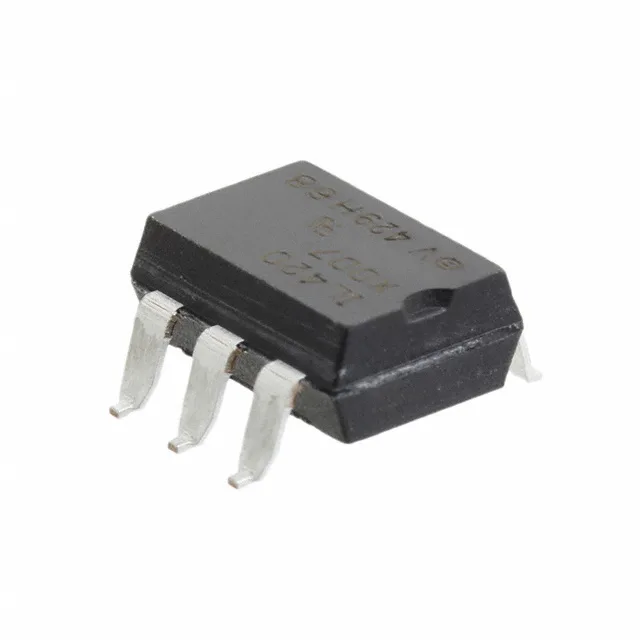
The IL4108-X007T is a single-channel triac-output optocoupler from Vishay, built for driving AC loads from a logic-level control side with reinforced isolation. Its 5300 Vrms isolation rating covers basic insulation for mains-referenced circuits — think motor contactors, valve actuators, and solid-state relays in industrial panels. The 800 V off-state voltage gives enough headroom for 240 VAC line switching with margin for transients, so you are not derating at the nominal line. The zero-crossing circuit turns on the triac only near the AC voltage zero, which cuts inrush current and conducted EMI on resistive loads — heaters, lamps, solenoid valves. Without it, random-phase turn-on can spike the load and stress the triac. The 35 µs turn-on time is fast enough for line-frequency switching but not for PWM; this is an on/off part, not a dimmer.
10 kV/µs dV/dt — why it matters in a motor drive cabinet
Static dV/dt immunity is rated at a minimum 10 kV/µs. In a noisy environment — VFD output, contactor bounce, relay chatter — fast voltage edges can capacitively couple across the optocoupler barrier and trigger the triac falsely. This part's 10 kV/µs floor means it will hold off most industrial transients without an external snubber, saving PCB space and BOM cost. The 500 µA holding current is standard for triac output; it keeps the load latched once triggered until the AC current drops below that level at the zero crossing.
Active, ROHS3, and the sourcing picture
ROHS3 compliant, no exemption issues. CSA and UR approvals are on file, which simplifies safety certification for end equipment sold into North American markets.