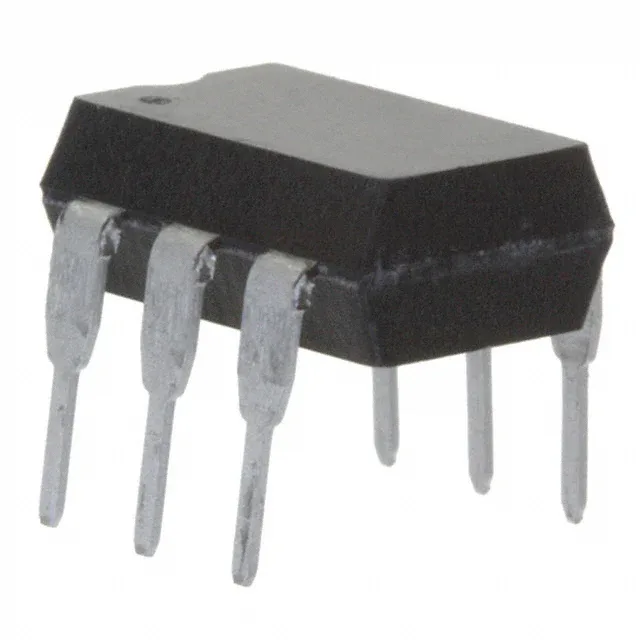
The H11D2 is a single-channel optocoupler in a 6-pin DIP through-hole package, built around a phototransistor output with the base brought out. Its 5300Vrms isolation rating and 300V output voltage ceiling place it squarely in industrial and power-conversion applications — motor drives, switched-mode power supply feedback loops, PLC input/output modules, and high-side relay drivers where the load side runs at 120VAC or 240VAC and the control side needs galvanic separation. The base-access output gives the designer the option to add external bias or speed-up circuitry, which is useful when the phototransistor's native rise/fall times (2.5µs, 5.5µs typical) need to be pushed for higher data rates or when the CTR (minimum 20% at 10mA forward current) needs tailoring across temperature.
5300Vrms isolation and 300V output — the real-world fit
The 5300Vrms isolation voltage is the spec that decides whether this part can sit on a 240VAC line without creeping or arcing across the creepage gap of the 6-DIP package. It is rated for reinforced insulation in many designs, which means it can serve as the sole isolation barrier between the mains-referenced side and the low-voltage control side in a power supply or motor drive. The 300V output rating on the phototransistor side means it can switch a 24VDC relay directly, or drive the gate of a small MOSFET or TRIAC through a series resistor — no extra level-shift transistor needed. The 100mA output current per channel is enough to saturate a standard 24V relay coil or drive the LED in a second optocoupler in a cascaded isolation scheme.
The -55°C to 100°C operating range covers outdoor telecom cabinets, factory-floor enclosures, and engine-bay electronics without derating. The 5µs turn-on and 6µs turn-off times (typical) are adequate for 50/60Hz line-synchronous switching, relay-coil drive, and low-speed digital isolation up to about 10 kbps. For faster signals — serial data or PWM above 50 kHz — the base-access pin lets you add a base-emitter resistor to sweep stored charge faster, trading CTR for speed.