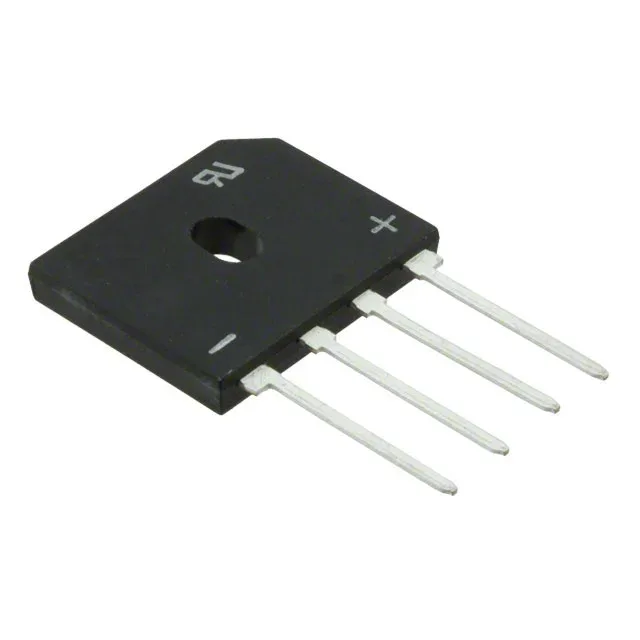
800 V bridge in a standard GBU footprint
The GBU8K-E3/45: The GBU8K-/45: The Vishay GBU8K-/45 is a single-phase bridge rectifier using standard silicon technology, housed in the industry-standard 4-SIP GBU through-hole package. It delivers an average rectified output current of 3.9 A and is rated for a peak repetitive reverse voltage of 800 V — a common selection for universal-input AC-DC power stages up to 480 VAC line. The forward voltage spec of 1 V at 8 A gives a reasonable conduction-loss baseline for heatsink sizing in continuous-duty supplies, motor-drive auxiliary rails, and battery chargers.
Junction temperature rating sets the thermal boundary
The 150°C upper limit is the key number for power dissipation calculations — at 3.9 A average with a typical forward drop, the I²R losses dictate whether a standalone GBU package can free-air cool or needs a clip-on heatsink. The -55°C floor means it handles cold-start in outdoor telecom cabinets and unheated equipment shelters without derating.
Reverse leakage at rated voltage
Maximum reverse leakage current is 5 µA at the full 800 V reverse voltage. This is a standard-recovery bridge — no fast-recovery or soft-recovery characteristics — so it is suited for 50/60 Hz line rectification rather than high-frequency switching stages. The low leakage helps maintain efficiency in light-load or standby conditions where the bridge is still biased but delivering minimal output current.
Package and mounting — GBU SIP with tube delivery
The through-hole mounting suits wave-solder assembly or hand-rework in prototype and repair scenarios. The GBU footprint is shared across the entire GBU8K voltage family — a board laid out for the 600 V, 800 V, or 1000 V variant accepts this part pin-for-pin, which simplifies voltage-derating upgrades without a PCB revision.
ROHS3 compliant — no exemptions that would trigger a restricted-materials review for EU or California-market products. No PCN or successor part is cited in the current data, so this remains the direct orderable part for new and sustaining production.