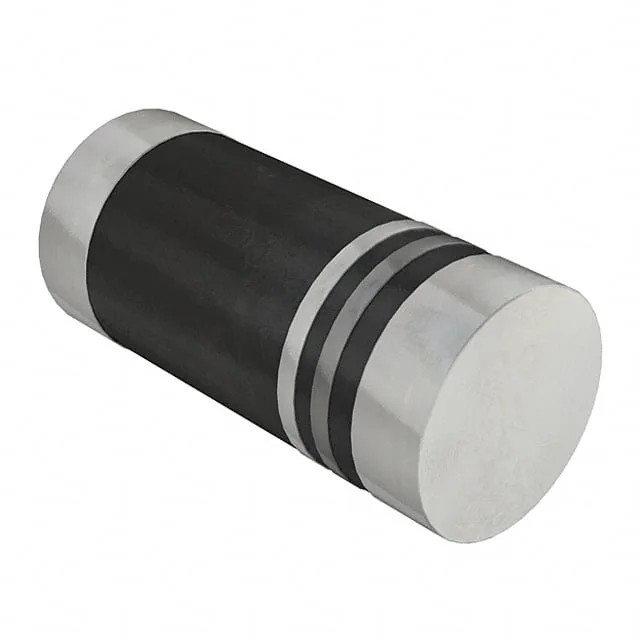
50 ns reverse recovery — the switching-loss ceiling
The EGL34G-E3/98: The EGL34G-/98: The Vishay SUPERECTIFIER® EGL34G-/98 is a 400 V, 500 mA fast-recovery rectifier in a hermetic DO-213AA glass package. Its 50 ns reverse recovery time (trr) is the parameter that decides the switching-loss budget in flyback snubbers, PFC boost diodes, and secondary-side freewheeling paths where the recovery charge would otherwise hammer the MOSFET or controller.
400 V / 500 mA — where the envelope fits
Rated 400 V reverse and 500 mA average forward, this diode sits in the low-to-mid current tier of fast-recovery rectifiers. The 400 V blocking voltage gives headroom for 240 VAC line rectification (peak ~340 V) with derating margin. The 500 mA average current limits it to auxiliary supply rails, gate-drive bootstrap circuits, and low-power PFC stages — not the bulk output of a 100 W supply. Forward voltage is 1.35 V max at 500 mA.
Glass hermetic — the package that survives
The DO-213AA (GL34) is a glass-bodied, surface-mount package with hermetic sealing. Unlike plastic SMD packages, the glass construction resists moisture ingress and thermal cycling — relevant for sealed modules, outdoor telecom, downhole tools, and military/aerospace boards where conformal coating alone is not enough. The 7 pF capacitance at 4 V is low enough that it does not load high-frequency switching nodes. That 175°C ceiling is the absolute-max junction temperature; for a 500 mA average current in a 85°C ambient, the junction typically runs 30–40°C above case temperature, so the margin is generous even in hot environments.