Supply flexibility: single or dual rails
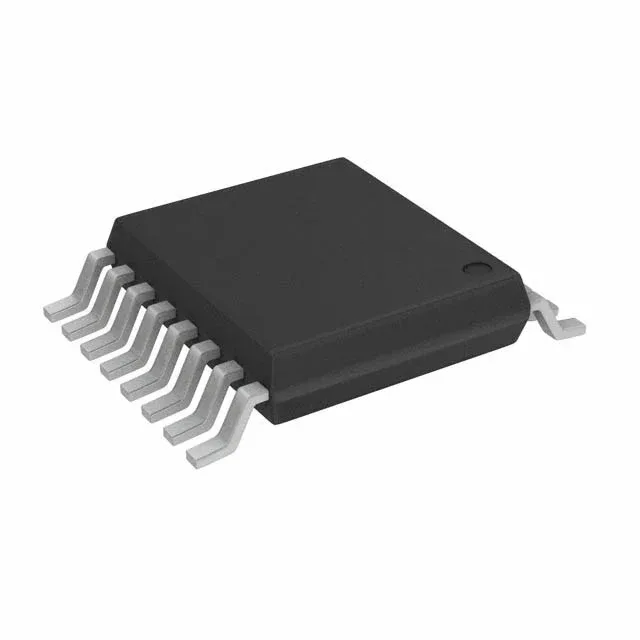
The DG411LEDQ-T1-GE3: Runs off a single 3V to 16V supply or a dual ±3V to ±8V rail — the same die works in a 5V-only system or a ±5V signal chain without a separate level shifter. Four SPST-NC switches in one 16-TSSOP package, each with a 1:1 multiplexer/demultiplexer configuration — normally-closed means the signal path conducts when the control pin is low.
On-resistance and switching speed — the real limits
26 Ohm max on-resistance is the ceiling across temperature and supply — for a 10 kOhm load that adds 0.26% gain error; for a 600 Ohm load the voltage drop is 4.3% of the rail, so budget the divider ratio. 50 ns turn-on and 30 ns turn-off max — the asymmetry matters: the switch opens faster than it closes, which prevents shoot-through in multiplexed sample-and-hold or ADC front-ends where the break-before-make window is critical.
Charge injection, leakage, and crosstalk — signal integrity check
6.6 pC charge injection is the glitch injected into the signal path when the switch turns off — in a 100 pF hold capacitor that translates to a 66 mV step, so a downstream buffer or longer settling time is needed for precision acquisition. 1 nA max off-leakage and 5 pF / 6 pF channel capacitance — the leakage is low enough that a 10 MOhm source impedance still sees under 10 mV of offset; the capacitance sets the -3 dB roll-off at roughly 500 MHz into a 50 Ohm load. -114 dB crosstalk at 1 MHz means adjacent channel feedthrough is more than 500,000:1 below the signal — adequate for 16-bit audio or multi-channel data acquisition where channel-to-channel isolation is the noise floor limit.