Active production — sourcing reality
The DF04SA-E3/77: RoHS3 compliant per the current Vishay material declaration, so no exemption expiry or substance-restriction risk for EU-market builds.
400 V peak reverse voltage means this bridge rectifier handles 240 VAC mains input with margin — the peak of a 240 V sine wave is ~339 V, so the 400 V rating covers line transients without avalanche stress. 1 A average rectified output (Io) is the DC load current the part delivers continuously at the rated junction temperature — a 12 W DC supply at 12 V draws 1 A, so this bridge fits low-power off-line supplies, relay coil drivers, and small motor drives. 1.1 V forward drop per diode at 1 A means ~2.2 V total drop across the bridge (two diodes conducting per half-cycle) — at 1 A output that is 2.2 W dissipated in the package, which the DFS body and gull-wing leads sink into the PCB copper.
DFS package — board-fit checklist
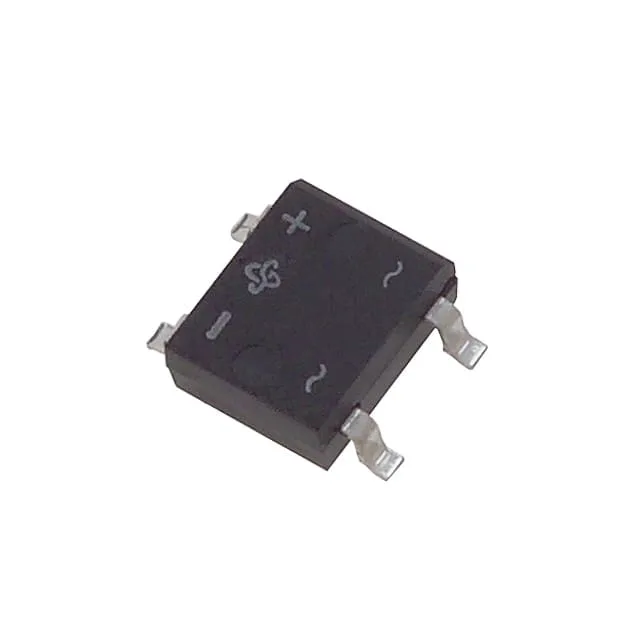
4-SMD gull-wing package (DFS) with a 10.3 mm body length and 8.5 mm width — the gull-wing leads provide a visible solder fillet for AOI inspection and relieve thermal stress between the ceramic die pad and the FR-4 board. Available in Tape & Reel (TR) for automated pick-and-place or Cut Tape (CT) for prototype and low-volume builds — the reel quantity is the standard 7-inch reel count for this body size. Single-phase bridge topology — four diodes in a full-wave configuration inside one package, so the PCB layout needs only four pads (two AC inputs, DC+ and DC-) instead of four discrete diodes and their routing.